
Every pyramid scheme needs a convincing costume to lure in unsuspecting victims.
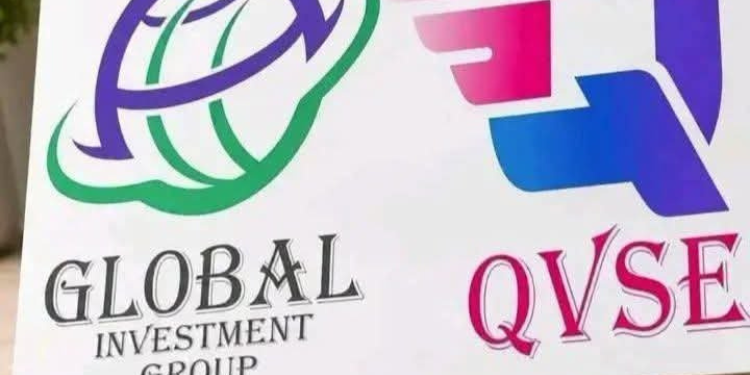
QVSE, which called itself Quant Vest Stock Exchange and operated in Kenya under the name Global Investment Group, chose one of the most persuasive costumes available: the aura of American capital markets. Apple. Tesla. Nasdaq. FinCEN. SEC. FINRA. SIPC.
An entire alphabet soup of trusted American acronyms, worn by a platform that a growing mountain of documentary evidence across two continents now reveals was never anything close to what it claimed to be.
This week, that elaborate costume finally fell apart in full public view.Kenyan investors who logged into their accounts on 4 September expecting to withdraw their funds were instead met with a notice that invoked the USA PATRIOT Act and a FINRA rule that doesn’t even apply to QVSE.
The notice blamed “severe violations” on the very customers who had placed their trust and their money in the platform.
What follows is the most complete public accounting yet of who QVSE truly is, how it managed to build a following inside Kenya’s staffrooms and trading floors, and why regulators on both sides of the Atlantic had already flagged it as unlicensed months before Kenyan authorities finally took notice.
A “New York exchange” that is three years younger than it claims to be QVSE tells potential investors that it was founded in April 2022 and is headquartered in New York.
Neither of these claims survives even the most basic check against public registries.
The only corporate entity that anyone has been able to trace Quant Vest Stock Exchange Limited, registered under Colorado entity number 20251650652 was incorporated on 9 June 2025.
That’s more than three years after the company claims it began operating.Its listed address, 3190 South Vaughn Way in Aurora, is not a bustling trading floor or a cutting-edge fintech campus. It’s a Regus-style serviced-office block, the kind of place where anyone can rent a mailbox and call it a headquarters.
Its registered agent, Quicker Business Solutions Inc. of Denver, is a commercial agent-for-hire precisely the kind of firm that anyone can pay to serve as the public face of a shell company while keeping the real operators hidden from view.
Danny de Hek, a New Zealand-based OSINT investigator who published an open-source review of the platform on 11 August, went searching for evidence of the three years between QVSE’s claimed founding and its actual incorporation.
He found absolutely nothing. No Wayback Machine captures. No earlier trading name. No predecessor entity. Nothing at all.
The first trace of the company’s current domain that any archive can confirm dates to August 2026 just weeks before its Kenyan customers were locked out of their own money.
A stock certificate circulated in QVSE’s own promotional material, dated the same day as the Colorado filing, names one Marc Hudon as holder of ten million shares.
On the face of the document, that represents the platform’s entire authorised share capital.
De Hek’s investigation could not find a verifiable professional history for Hudon anywhere. No LinkedIn trail. No banking career to verify. No fintech record that predates the certificate that supposedly makes him a major shareholder in an American “stock exchange.”
Promotional materials separately name a “New York spokesperson,” Robert Hayes but the New York headquarters he is meant to represent has never been located by anyone who has looked.
The regulatory alphabet soup simply doesn’t add up.
QVSE’s pitch to Kenyans leaned entirely on creating the impression of heavy American regulatory oversight: FinCEN, SEC, FINRA, SIPC, RIA status, AML, KYC.
But when you pull these acronyms apart one by one, the claims contradict each other and, in some places, even contradict themselves.
The one filing that is genuinely real is a FinCEN Money Services Business registration, number 31000302288613, received on 10 June 2025 the day after the company was incorporated.
But an MSB registration is emphatically not a trading licence.It registers a firm as a money transmitter for anti-money-laundering purposes.
FinCEN’s own paperwork states plainly that the bureau does not recommend, approve, endorse, or verify anything an MSB submits. It’s the regulatory equivalent of a business permit, not proof that a firm can lawfully execute stock trades for the public.
Yet QVSE’s own materials, when examined side by side, cannot even agree on what they are claiming.
One legal disclaimer describes the company as “a stock exchange strictly regulated” by the SEC and FINRA.
Elsewhere, on its own compliance page, the same platform states that SEC, FINRA and SIPC registration is “still underway.
“Its roadmap lists completing an “SEC securities dealer license upgrade” as a 2026 target an explicit admission that the licence does not yet exist while simultaneously advertising
“Leveraged Trading Unlimited Potential” as a live feature and listing “RIA (Registered Investment Advisor) – SEC Regulatory” among its current qualifications, not future ambitions.
De Hek’s investigation also flagged the legal agreement that Kenyan and other investors are asked to accept before depositing funds: a template that appears to have never been finished.
Under “Applicable Law,” the document states it “shall be governed by and construed in accordance with the laws of [for example: Delaware]” the placeholder text left sitting right there in the final version.
The arbitration clause names no state either.Buried in the same unfinished contract is a liability cap that should alarm anyone who reads it closely: even if QVSE’s disclaimers fail in court, its total liability is capped at the fees a customer paid in the past twelve months not the amount deposited, not the value of the “stocks” supposedly purchased.
Fees only.
No part of that paper trail shows a named broker-dealer executing trades, a custodian holding securities, or an auditor watching customer funds despite QVSE’s claim that its crypto deposits sit in “multi-signature cold wallet storage” that is “audited by regulatory authorities.” No such regulator has been identified, either by QVSE or by anyone investigating it.
Ghana flagged it in July.
Kenya’s Parliament caught up in August.
Six weeks before Kenya’s National Assembly ordered a formal probe, Ghana’s Securities and Exchange Commission had already taken action.
In a public notice dated 22 July 2026, the Ghanaian regulator named 23 online entities that it said were promoting investment products without a licence under the Securities Industry Act.
The regulator warned the public to stay away from all of them.
Quant Vest Stock Exchange (QVSE) was on that list.
So, separately, was a near-identical entity called QVES. So was BG Wealth, a copy-trading and crypto-recruitment platform that De Hek had already flagged as structurally similar to QVSE before he ever found the Ghana notice the same architecture of “professional traders,” crypto deposits and referral-driven growth, sold under a different brand name.
This is not a coincidence of naming.
This is a pattern that regulators are now watching across borders: multiple platforms, near-identical playbooks, all unlicensed, all still able to advertise freely on the very continent where their investors live.
Kenya’s Parliament moved only once its own citizens started complaining in significant numbers.On 12 August, Matungulu MP Stephen Mule told the National Assembly that QVSE was targeting “everyday citizens such as small-scale traders and other economically vulnerable groups,” requiring a minimum deposit of roughly Sh65,000 and restricting investors to a single trade per day once notified by the company.
He told the House that investors could not withdraw their principal at all.
Speaker Moses Wetang’ula gave the Finance and National Planning Committee, chaired by Kuria Kimani MP, two weeks to establish QVSE’s legal status in Kenya, its ownership and local agents, and what protection existed for victims.
Education-sector reporting the same month recorded a related and specific alarm: teachers were taking out loans against their salaries to raise the Sh65,000 buy-in.
That was the point at which a recruitment scheme stopped being a rumour in a WhatsApp group and started running through an entire profession’s payroll cycle.
Kenya’s Capital Markets Authority and Central Bank have never published a QVSE licence, because none exists.
The Virtual Asset Service Providers Act, 2025 is now in force, with CMA and CBK designated as the licensing authorities and a compliance transition period running toward 4 November 2026 for platforms serving Kenyans. QVSE and Global Investment Group do not appear on any CMA licensee list not among fund managers, not advisers, not brokers, not forex dealers.
How the machine actually worked
Strip away the Nasdaq branding and what you’re left with is a recruitment engine that Kenyan bloggers and independent reviewers had already started mapping months before Parliament acted.
According to an account published on Kenyan outlet Venas News in May, more than 7,000 Kenyans had already subscribed to the platform by that point.Entry required a deposit of roughly $500 broadly matching the Sh65,000 figure MP Mule later cited to Parliament.
After depositing, the account would begin “growing,” and promoters would advertise daily returns of a few dollars, pitched explicitly at people with no trading experience whatsoever.
Referral bonuses were built directly into the structure: reported figures put the reward at $50 for every referred deposit of $500, and $100 for every $1,000.
Registration was gated so that new users could not sign up without an existing member’s invitation code.
De Hek’s own technical capture of the platform independently confirmed that the invite-code mechanism was live on the site, embedded directly in the registration URL itself.
That is not how a stock exchange recruits customers. That is how a network-marketing scheme recruits distributors.
A legitimate trading platform does not need to know how many friends a customer has brought in before granting “signal trading permissions” or upgrading someone to “spokesperson” status but that is precisely the unlock structure that investors describe.
The label on the tin said exchange. The mechanics underneath it were referral commissions.Guaranteed daily returns funded by new deposits.
Early withdrawals used as advertising. A share-your-invite-code growth model. And when the money stopped flowing in fast enough to pay it back out a sudden pivot to blaming the customers.
QVSE’s own September notice cited “severe violations” inside Global Investment Group: multiple accounts, shared logins, unresolved beneficial-ownership checks.
It invoked the PATRIOT Act and FINRA Rule 3310 a FINRA anti-money-laundering rule that applies only to FINRA member firms, which QVSE, by its own admission elsewhere, is not.
A regulated broker that discovers multi-accounting freezes the offending accounts and pays everyone else.
A scheme that needs the float freezes the entire class and recites statutes it does not operate under.
What investigators should already be pulling
Between Ghana’s July warning, De Hek’s August corporate-records investigation, and Kenya’s own Parliamentary record, the outstanding questions are no longer mysterious—they are simply unanswered:
What entity, if any, operated under the QVSE name in the three years before the Colorado corporation existed?
What is Marc Hudon’s relationship to the company today, and what is the verifiable professional history behind the ten-million-share certificate in his name?
Which FINRA-registered broker-dealer, specifically, executes the Apple and Tesla trades shown on Kenyan dashboards and where are those securities actually held?
Who are QVSE’s and Global Investment Group’s local agents, trainers and group administrators inside Kenya, and how much money moved through them in USDT before conversion?
Why was a platform that Ghana’s regulator had already blacklisted in July still being marketed to Kenyan teachers in August?
Kenya’s Directorate of Criminal Investigations and the Assets Recovery Agency do not need to wait on a committee report to start tracing wallets.
FinCEN’s own filing gives them a legal name, a Colorado entity number and a physical mail-drop.
Ghana’s SEC notice gives them a contemporaneous foreign warning naming the same platform. Hansard gives them a named MP, a documented date, and victims concentrated in a profession teaching that the state already knows how to reach.
The receipt, not the market
QVSE’s Kenyan customers were not buying an obscure altcoin they’d stumbled on in a dark corner of the internet.
They were sold America. A New York address that does not exist.
A stock exchange license that is “still underway.” A CEO with no verifiable past. And a compliance vocabulary borrowed wholesale from institutions that have never certified this platform.
What they received in exchange was a dashboard showing numbers that never left the company’s own database, a growth model that ran on their friends’ deposits, and a freeze notice dressed up in statutes that do not apply to them.
The profits are still glowing on the screen in thousands of Kenyan homes tonight.
That is not a market functioning normally. That is the receipt for money that already left the building.