
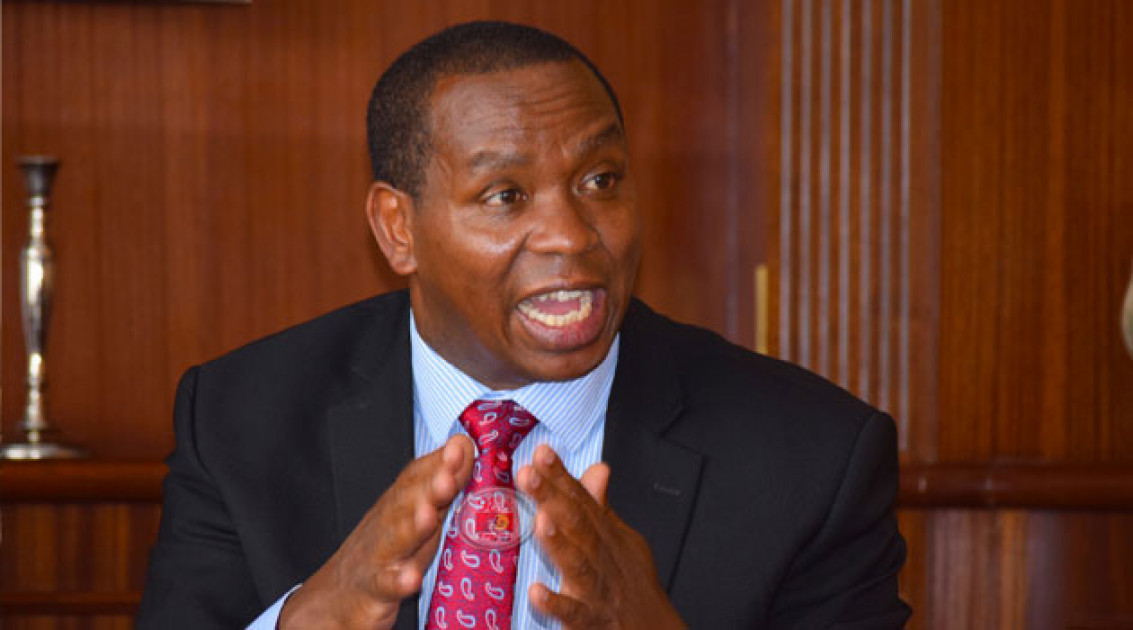
Ndiritu Muriithi is facing an uncomfortable political moment after President William Ruto ordered a reversal of the controversial customs benchmark that the KRA Board Chair had strongly defended.
For weeks, Muriithi stood by the decision to raise the minimum customs benchmark for consolidated container cargo from KSh2.5 million to KSh3.2 million.
He argued that the move was not a tax increase but an adjustment meant to deal with undervaluation and improve revenue collection.
Traders, however, saw it differently. To many small importers, the change meant higher costs at a time when businesses were already struggling with rising expenses and weak consumer demand.
Muriithi remained firm even as traders from areas such as Gikomba, Kamukunji and Nyamakima protested against the new system.
Instead of backing down, he defended the policy, insisting that traders could deconsolidate their goods at bonded facilities and pay duty only on their individual consignments.
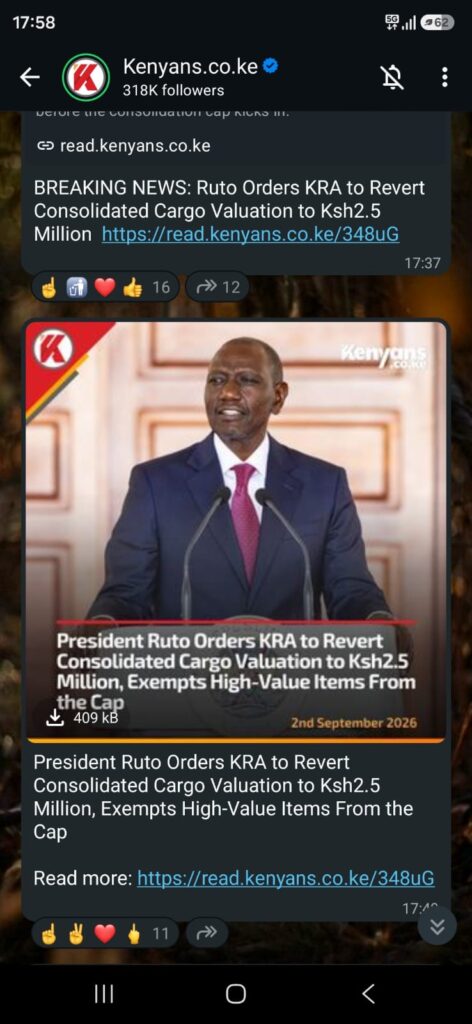
That position has now become a political embarrassment.Ruto has stepped in and ordered KRA to lower the benchmark, with reports indicating that it could return to KSh2.5 million or fall further towards KSh2 million.
The President also directed that high-value goods be identified separately and that a clear list be published so traders can understand what will be excluded from the consolidated arrangement.
The President further ordered Kenya Railways to reduce freight charges for deconsolidation cargo and address problems at the Boma facility.
The message could hardly be clearer: the government has acknowledged that the policy, at least in its current form, went too far.
That leaves Muriithi with a serious credibility problem.
The man who had confidently defended the higher benchmark has now been overtaken by the very political leadership he was expected to support. What he presented as a necessary revenue measure has been subjected to a major rethink after traders pushed back.
For ordinary business owners, this is not simply a policy disagreement. It is about survival. Many traders complained that the increased benchmark would raise their costs and make it harder to keep their businesses running.
Their anger eventually spilled onto the streets, forcing the government to respond.
Muriithi’s biggest problem is therefore not just that the policy has been revised. It is the manner in which he defended it while traders were raising genuine concerns.
The situation becomes even more politically sensitive because Muriithi is reportedly eyeing a return to elective politics in Laikipia. If he intends to seek the governor’s seat again, his handling of the customs controversy could follow him into the campaign.
Voters may ask a simple question: when traders were hurting, whose side was he on?
The KRA chair can argue that his responsibility was to protect government revenue. That is a legitimate duty. But leadership also requires recognising when a policy is creating more pain than the public can absorb.
Ruto’s intervention has exposed that gap.
Muriithi may have believed he was defending the government’s revenue agenda, but the President has now effectively told the country that the approach needed to change.
The result is an awkward political picture: a senior state official defending a measure that his own boss has now ordered to be softened.
For a man with political ambitions, that is a difficult position to explain.
The KSh3.2 million benchmark may have been presented as a technical customs issue, but the political damage is anything but technical. Muriithi defended the increase when traders wanted relief.
Ruto has now provided that relief.
And in doing so, the President has left the KRA chair facing the consequences of a decision he once defended so confidently.




Leave feedback about this