
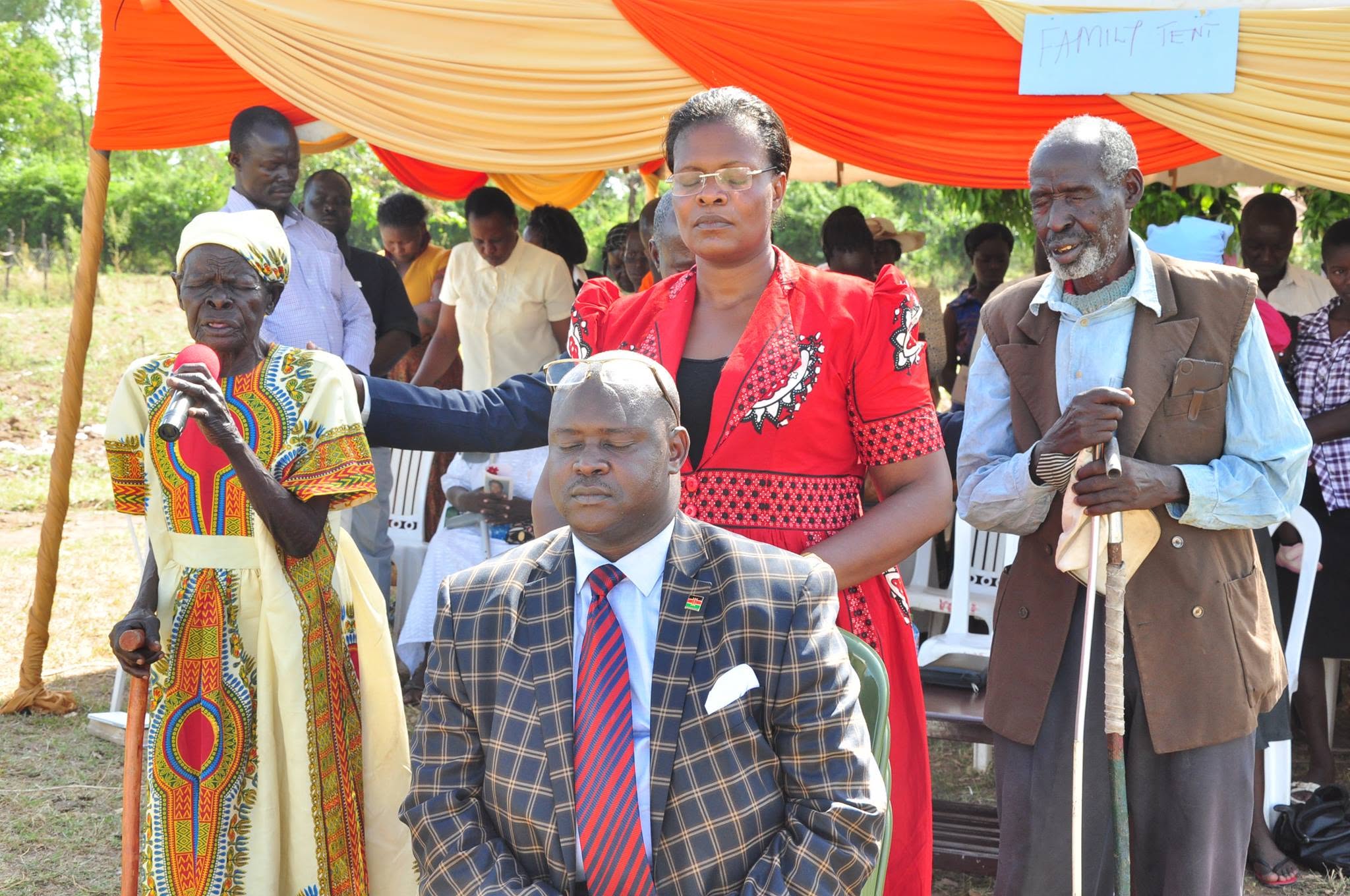
For Seth Steve Okute, the journey to Parliament did not begin with a campaign poster, a political rally or the declaration of an election bid.
It began much earlier, in the deep Karachuonyo plains where the needs were immediate and the solutions could not wait for political office before being addressed.
Across Karachuonyo, Okute has spent years building a public profile around community engagement, empowerment and social support. His political ambition has grown alongside that work, giving his current bid for the Karachuonyo parliamentary seat a narrative that is different from the conventional promise to start serving once elected.
His message has been simple and straightforward that leadership should not begin on the day one takes the oath of office.
That philosophy has increasingly become the foundation of Okute’s campaign as he seeks to convince Karachuonyo voters that his interest in public office is an extension of work he has already been doing at the grassroots.
A political journey built over time
Okute is not a newcomer to the Karachuonyo political contest. He was among the candidates who contested the Karachuonyo parliamentary seat in the 2022 General Election. His current campaign is therefore not the product of a sudden political awakening, but another chapter in a longer pursuit of elective office.
That persistence has become an important part of his political identity.
Rather than presenting his earlier attempt as a failure, Okute’s political journey can be read as one of persistence – returning to the people, listening to their concerns and continuing to build relationships at the grassroots.
It is a strategy that places considerable emphasis on presence. And in an electoral environment where voters are often approached most intensely during campaign season, sustained grassroots engagement can become a powerful political asset.
Service before the ballot
The strongest element of Okute’s story is the work associated with his community organisation, the Africa Underprivileged Empowerment Network Initiative, or AFUENI.
Through the organisation, his activities have included initiatives targeting young people, women, education and vulnerable members of the community. Reporting on his work describes vocational training and empowerment programmes, support for women involved in small-scale economic activities and education initiatives aimed at helping children from disadvantaged backgrounds.
That approach reflects a particular understanding of empowerment. Instead of focusing exclusively on handouts, Okute has repeatedly spoken about giving people opportunities to become economically productive.
For young people, that has meant skills and opportunities. For women, it has included support for income-generating activities. For pupils and students, it has meant education support.
The distinction matters because Karachuonyo’s development challenges cannot be solved by short-term interventions alone. The larger question is whether communities can develop the skills, infrastructure and economic opportunities required to become less dependent on assistance.
That is where Okute’s political message increasingly intersects with his community work.
From classrooms to livelihoods
Education has emerged as one of the recurring themes in Okute’s public engagements.
Recent reports cite his involvement in a school feeding programme at Soko Kogira Primary School, an initiative intended to help children remain in school and concentrate on their education. His support for education has also featured through bursary and mentorship initiatives.
His interventions have not been limited to classrooms but have also extended to livelihoods and the working environment of ordinary residents.
The construction of boda boda sheds, for example, has been highlighted as part of his grassroots activities, providing operators with more secure and sheltered working spaces. His support for local sports has similarly been presented as an investment in young people’s potential, including the reported opportunity secured abroad by a promising athlete.
These may appear to be modest interventions when compared with the size of Karachuonyo’s development needs, but that is precisely the point of Okute’s political argument.
Development, in his telling, is not only about major infrastructure projects. It is also about whether a child can remain in school, whether a young person can acquire a useful skill, whether a trader can operate in better conditions and whether local talent can find a pathway beyond the constituency.
Health as another measure of leadership
Health has also featured prominently in Okute’s community record and political agenda. A report published in November 2025 attributed to him the donation of 16 hospital beds to dispensaries across the constituency in 2016. The same report highlighted his more recent community engagements encouraging residents to register with the Social Health Authority.
His broader health agenda includes strengthening community-level healthcare and working with the county government to improve access to services, and the significance of such a programme is straightforward.
For many rural families, healthcare is not simply a question of whether a facility exists. It is about whether that facility has the equipment, personnel and capacity to respond when a family needs it.
Okute has sought to position himself as a politician who understands that reality from the community level.
Listening before promising
Perhaps the clearest indication of how Okute wants to campaign in 2027 is his emphasis on listening.
Recent engagements in Karachuonyo have centred on conversations with residents about water, unemployment, infrastructure and local economic opportunities. Rather than presenting a single solution to every problem, his message has increasingly focused on finding practical and lasting responses to issues residents identify themselves.
That is important because the constituency’s challenges are broad; Water affects households, farmers and businesses, unemployment affects young people and families, poor infrastructure constrains trade and mobility, education determines whether the next generation can compete beyond the constituency, and healthcare determines whether families can withstand emergencies without falling into deeper financial hardship.
For Okute, these issues form the bridge between his community activities and his parliamentary ambitions.
A campaign gaining attention
The emerging political contest has also begun generating numbers.
A July 2026 Mwelekeo Insights online poll placed Okute first among the listed Karachuonyo parliamentary aspirants, giving him 49.5 per cent of the 604 valid responses while while other aspirants recorded smaller shares.
The figures continue to show Okute’s growing political standing, clearly showing that his sustained grassroots campaign is beginning to attract attention beyond the individual community initiatives that have defined his public profile.



Leave feedback about this