
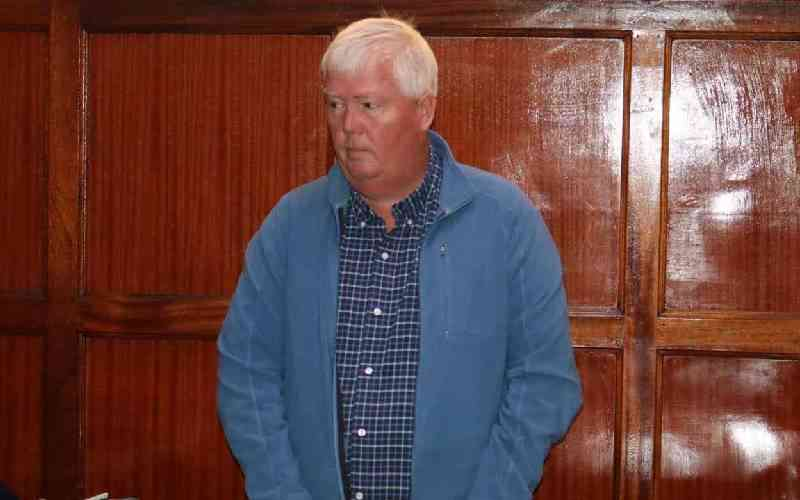
The name of lawyer Guy Spencer Elms continues to surface in troubling cases that raise questions about integrity in Kenya’s legal and property sector.
The Directorate of Criminal Investigations has turned its attention to him again, this time over allegations that he forged the will of the late billionaire Pritam Singh Panesar.
At the center of the dispute is a 53-acre beachfront estate in Msambweni, Kwale County, a prime piece of land that has attracted a long and bitter court fight.
Panesar died in July 2018, and Elms, alongside Nileshkumar Shah, presented themselves as joint executors of his will, but forensic experts have now raised serious doubts about the authenticity of the signature on the document.
The Msambweni land has not only been a target of powerful individuals but also home to locals who had occupied it for years.
In 2022, the Environment and Land Court recognized three men, Mohammed Ruwa Maridadi, Anthony Michael Mwanza Mulwa, and Ahmed Ouma Randa, as the rightful owners through adverse possession.
They had lived there openly for more than 12 years, investing in homes, boreholes, and planting mature trees. That ruling should have ended the matter, but Elms and Shah challenged it, arguing they were unfairly excluded.
Their appeal reopened the dispute, yet what makes the case even darker are the findings around the alleged forged will.
A DCI forensic examiner, Alex Mwongera, compared Panesar’s national ID signature with that on the contested will and found major inconsistencies.
He pointed to differences in pen movement and character design, suggesting it was not genuine. Another expert, Emmanuel Karisa Kenga, reviewed signatures from nine other documents and reached the same conclusion.
This means the entire fight over the land rests on a fraudulent foundation. Adding to this is a sworn affidavit by Henry Philip Nyabuto, who admitted creating a fake Green Card for the land registry after being approached by a former police officer allegedly working for Elms.
Nyabuto even produced an M-Pesa record showing he was paid Sh10,000 in January 2022, further fueling claims of a coordinated scheme to alter ownership documents.
This scandal is not an isolated one for Elms. His name is tied to the long-running case of British tycoon Roger Bryan Robson, who died in 2012. Elms was accused of forging Robson’s will and power of attorney to control properties in Karen and Upper Hill worth hundreds of millions.
Businesswoman Agnes Kagure insisted she had purchased one of the parcels before Robson’s death, but Elms disputed this in his role as executor. Forensic reports in that matter also raised red flags, and although some experts later defended him, the damage to his reputation was clear.
In fact, just recently, an arrest warrant was issued against him after he failed to appear in court for charges of making false documents and attempting to grab land. His excuse of attending to a sick child abroad did not stop the warrant from being issued.
Elms has often tried to position himself as a seasoned conveyancing lawyer handling residential and commercial transactions, but the string of accusations paints a picture of a man deeply entangled in questionable dealings.
Allegations have linked him to land cartels, tax evasion schemes, and offshore financial tricks.
The Kwale case once again highlights how lawyers and powerful players exploit gaps in inheritance and land laws, often at the expense of ordinary people.
The future of the Msambweni land remains uncertain. Locals still use parts of it for grazing, but their fate is tied to a legal battle that has dragged on for years. What stands out is that Elms has become a recurring figure in Kenya’s biggest land disputes, and the repeated appearance of forgery claims against him raises serious questions about accountability within the profession.
If this case ends with more evidence against him, it could expose just how deep corruption runs in the handling of wills and estates in the country. For now, his name remains a symbol of the broken trust between Kenyans and those meant to uphold justice in matters of property and inheritance.


Leave feedback about this