

A growing debate is taking shape around leadership and development after Millie Odhiambo openly questioned the pace of progress in Homa Bay County.
Her remarks have drawn attention because they rely on clear examples from Kiambu County, where several health projects have already been completed and are in use.
Instead of focusing on political arguments, Odhiambo pointed to visible changes on the ground. She highlighted facilities such as Thogoto Level 4 Hospital, Karuri Level 4 Hospital, and Juja Level 4 Hospital, describing them as working institutions that are already serving residents.
These projects have become part of a broader discussion on how counties are managing development under devolution.
She also mentioned smaller facilities like Ndenderu Level 3 Hospital and Kahawa Sukari Level 3 Hospital. By including both large and grassroots projects, her message created the impression of consistent planning and delivery across different levels of healthcare in Kiambu.
This approach has strengthened her argument, as the evidence she presents is easy to verify.
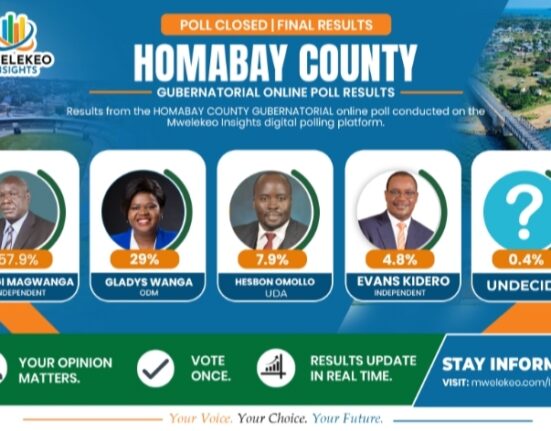
The comparison has inevitably shifted focus to Homa Bay County and its leadership under Gladys Wanga. Questions are now being raised by residents and observers about what has been achieved at a similar scale.
While every county faces its own challenges, the contrast has made it harder to avoid direct comparisons.
For many residents in Homa Bay, the discussion is no longer about political loyalty but about results that can be seen and felt.
Access to healthcare remains a key issue, and the presence of modern, fully operational hospitals in another county has made the gap more noticeable.
This has led to frustration among some locals who feel progress has been slower than expected.
Analysts note that Odhiambo’s strategy has changed the tone of the conversation.
By focusing on completed projects rather than promises, she has placed the spotlight on measurable outcomes. This kind of comparison tends to resonate more with the public because it is based on real experiences rather than projections.
The pressure is now building on county leadership to respond with clear evidence of progress. Defending performance through statements alone may not be enough in a situation where physical projects are being used as the benchmark.
Citizens are increasingly looking for services they can access, not plans they are told about.