
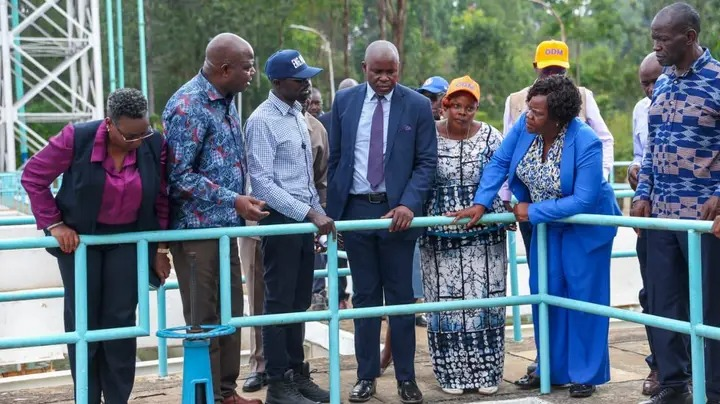
The recent commissioning of a water project in Homabay County has turned into a spectacle of embarrassment, laying bare the deep-seated issues of incompetence and potential corruption that continue to plague our leadership.
At the center of this storm is Governor Gladys Wanga, a leader whose administration is increasingly being defined by questionable decisions and a complete lack of accountability.
The event, which was meant to be a celebration of progress, quickly devolved into a public lecture when Water Cabinet Secretary Eric Muuga arrived and exposed the rot that is festering within the county’s operations.
The CS, who was invited as a guest of honor, did not hold back his disappointment upon discovering that the county had entrusted a critical water treatment project to an engineer who clearly lacked the necessary expertise.
This was not a simple oversight; it was a dangerous gamble with public resources and the health of the people who depend on clean water.
The sheer magnitude of this blunder is staggering.
A water treatment plant is a complex facility that requires skilled and experienced professionals to operate and maintain.
The CS pointed out a basic operational failure related to the “backwash” process on the rapid sand filters, a standard procedure that any competent water engineer would know by heart.
The fact that this basic knowledge was missing points to a system that has completely collapsed. It points to a culture where competence is not a prerequisite for employment, where jobs are handed out as favors rather than earned through merit.
The public is not naive; many online observers have already voiced their suspicion that this inexperienced engineer is likely a relative of the governor. This is not a far-fetched conspiracy theory; it is the natural conclusion drawn from a political landscape where nepotism is the order of the day.
Governor Wanga’s complete lack of understanding of the technical issues being discussed was equally telling. While the CS was talking about critical technical processes, she was reportedly asking questions that revealed a profound disconnect from the core functions of her own administration.
This incident is not just about one incompetent engineer or one embarrassing public event. It is a window into the soul of the Wanga administration. It reveals a leadership that is either willfully blind to the operations of its own government or, worse, actively complicit in allowing unqualified people to manage critical public services.
The people of Homabay deserve better. They deserve leaders who will prioritize their well-being over family connections and political favors. They deserve a governor who understands that the responsibility of managing public funds and resources comes with an absolute duty to ensure that the most qualified individuals are in charge.
Instead, they are given a leader who seems more interested in photo opportunities and political grandstanding than in ensuring that the water they drink is safe and that their tax money is not being wasted on incompetent cronies.
The CS’s actions should be commended; he did not shy away from publicly calling out the incompetence, a rare act of courage in a country where officials often prefer to sweep such failures under the rug.
We must ask ourselves, how many other projects in Homabay are being managed by unqualified relatives and friends?
How many other services are failing because the leadership is more concerned with political patronage than with good governance?
The rot that was exposed at this commissioning is likely just the tip of the iceberg. The governor’s silence and lack of a clear plan to rectify this situation speak volumes.