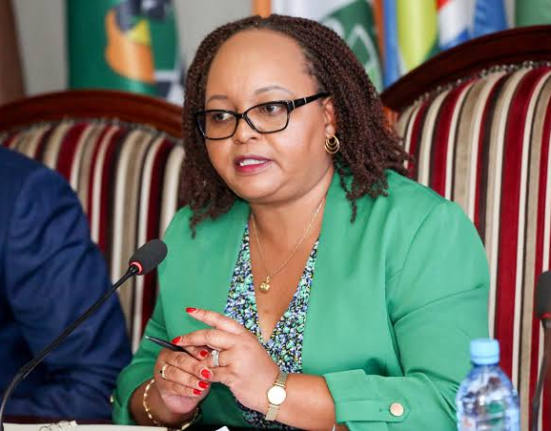

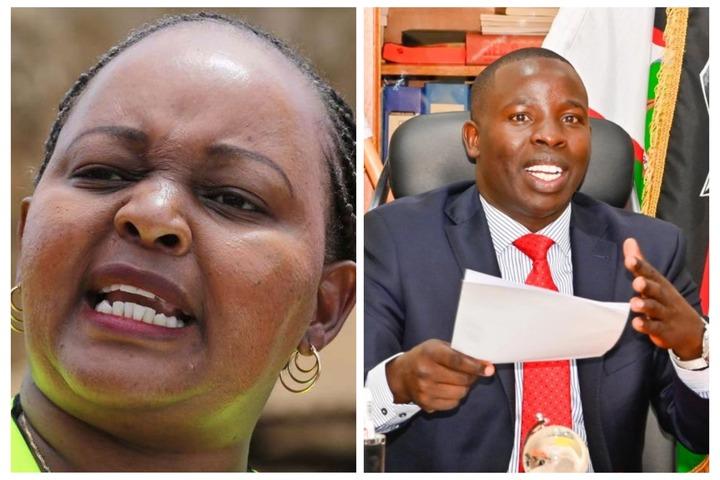
With the 2027 general election drawing closer, a silent but determined political reawakening is spreading among some of Kenya’s most experienced leaders.
17 governors, all serving their second and final terms, are preparing to leave county offices as required by the Constitution. Yet, while their official time in county leadership is ending, their political ambitions are far from over.
Instead of slowing down, many are preparing for fresh comebacks, hoping to shift their influence from county politics to the national stage.
Sources from within the political circles suggest that these outgoing governors are not waiting for 2027 to arrive before making their next move.
Many have already reconnected with campaign teams, revived old political alliances, and started attending strategic events aimed at keeping them visible.
Behind their calm public appearances lies careful planning and negotiation with key figures close to State House and political party headquarters.
Their plans range from seeking parliamentary positions, vying for cabinet appointments, to taking over leadership roles within their political parties.

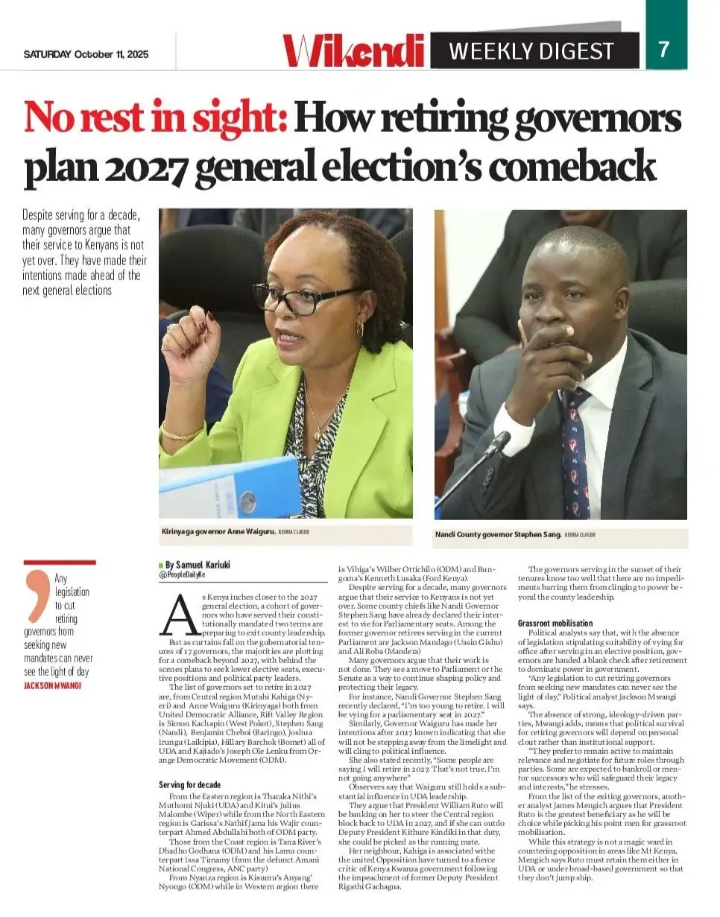
In the Central region, Governor Mutahi Kahiga of Nyeri and Anne Waiguru of Kirinyaga have been among those frequently mentioned in political discussions about post-2027 ambitions.
Both have been strong voices in Mount Kenya politics and are seen as influential figures capable of reshaping political alignments in the region.
In the Rift Valley, Governors Simon Kachapin, Stephen Sang, Benjamin Cheboi, Joshua Irungu, Hillary Barchok, and Joseph Ole Lenku are also set to complete their tenures, with some of them already hinting at higher ambitions.
Eastern Kenya will see Tharaka Nithi’s Muthomi Njuki and Kitui’s Julius Malombe complete their service, while in the North Eastern region, Garissa’s Nathif Jama and Wajir’s Ahmed Abdullahi will also vacate office.
On the Coast, Tana River’s Dhadho Godhana and Lamu’s Issa Timamy are expected to end their tenures, while Nyanza’s Anyang’ Nyong’o, Western’s Wilber Ottichilo, and Bungoma’s Kenneth Lusaka also join the list.
Collectively, these 17 governors represent a large group of political veterans whose next steps will likely influence how alliances are formed ahead of the 2027 race.
Many of them have publicly stated that their service to the country is not yet complete. Nandi’s Stephen Sang has been among the most outspoken, saying he intends to seek a parliamentary seat once his tenure ends.
His message that “I’m too young to retire” reflects a mindset shared by several of his colleagues who see county politics as just one stage of a longer journey.
Anne Waiguru has been equally firm in her position, saying that she will not disappear from the national scene. Her influence within the United Democratic Alliance remains strong, and she could play a key role in shaping Central Kenya’s political choices during President William Ruto’s bid for re-election.
Political analysts believe this group of governors will be central to the formation of coalitions in the next election cycle. Their experience in county management, networks across government, and understanding of local dynamics make them valuable to any party seeking national strength.
Kenya’s political stage may witness a renewed wave of familiar faces, not as governors, but as new players in Parliament, the Cabinet, and national party leadership.