
Standard Media through their widely read Standard Newspaper has sparked debate after deciding to investigate how President William Ruto has been relying on parliament to push through controversial bills.
Their latest report has linked the president directly to the passage of the 2024 finance bill, the impeachment of former deputy president Rigathi Gachagua, and the contested housing levy bill.
What has made the report stand out is the inclusion of leaked WhatsApp chats allegedly showing how the president was influencing members of parliament to vote in line with his interests.
This revelation raises questions about the independence of parliament and whether elected leaders are working for the people or for the executive.
The investigative piece detailed how the president was actively urging MPs to ensure that these controversial pieces of legislation were passed without much resistance.

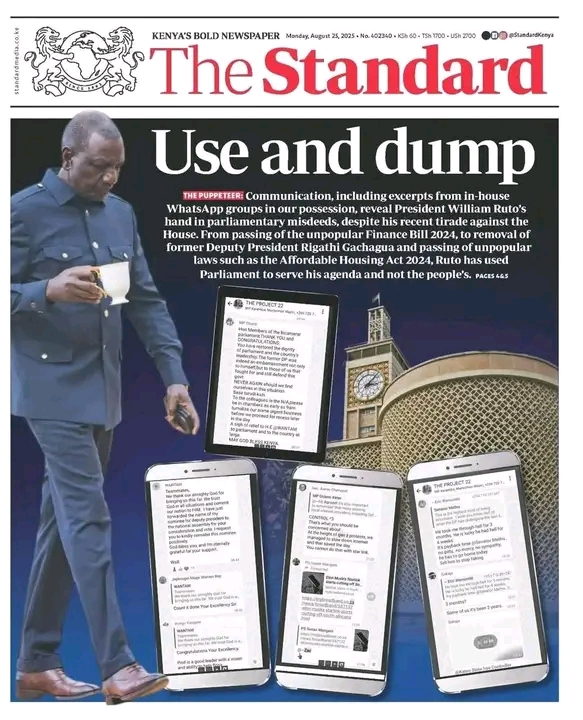
According to Standard, the conversations retrieved painted a clear picture of a parliament that has reduced itself to a tool for the executive, following instructions instead of debating in the best interests of the public.
The chats indicated direct communication where the head of state allegedly pushed for loyalty, reminding MPs of political consequences if they chose to resist his directives. Such exposure has brought to light the fragile state of democracy and representation in Kenya.
Parliament is constitutionally meant to safeguard the people’s voices, ensuring that laws and policies align with the will and needs of citizens.
However, what the Standard’s findings suggest is that a large section of MPs have abandoned this duty. Instead of analyzing the long-term effects of controversial policies such as the finance bill, which was met with countrywide resistance due to increased taxes, they seemed more focused on pleasing the president.
The same trend was seen in the housing levy bill, a matter that drew outrage from workers who felt the levy was a burden. In both cases, parliamentarians ignored the people’s voices and passed what the president wanted.The impeachment of Rigathi Gachagua further illustrated how parliament can be used for political convenience rather than justice or accountability.
The leaked communications reportedly revealed how lobbying was done aggressively, with MPs reminded of what was at stake if they went against the president’s plan.
This showed how political survival was valued more than constitutional duty, leaving many questioning if parliament is now nothing more than a rubber stamp for the executive.
What the Standard has done is expose a deep problem that ordinary Kenyans have been suspecting for years.
The revelations confirm that many MPs are no longer representing those who voted them in but are instead serving the president’s interests.
This undermines democracy and makes laws lose their legitimacy because they do not reflect the will of the people. If parliament is reduced to following instructions from State House, then the idea of separation of powers becomes meaningless.
What Kenyans are left with is a system where leadership is concentrated in one office, while elected representatives become mere messengers for the presidency.
This exposé by Standard has therefore ignited an important conversation about accountability, transparency, and the real role of parliament in Kenya’s democracy. It has shown that unless MPs reclaim their independence, Kenyans will continue to carry the burden of policies they did not ask for.
The revelations from the leaked chats are a warning that Kenya’s democratic institutions are under threat, and it is now upon citizens to demand better from those they elect.