


Nairobi workers are once again facing financial strain after the county administration under Governor Johnson Sakaja failed to honor its commitment of paying salaries on time.
What was once promised as a reliable payroll system has now become a source of stress and frustration for thousands of county staff.
The Kenya County Government Workers Union has openly criticized the Nairobi County leadership, accusing it of neglecting its duty and failing to put the welfare of employees first.
For a city that collects billions in revenue and still receives allocations from the national government, the continued excuse of delayed payments has become a clear sign of poor management and misplaced priorities.
The union noted that the county had earlier assured workers that delays would not be part of its operations. However, the same problems keep recurring, leaving employees uncertain about their financial future.
Many workers have reported being unable to pay rent, clear school fees, or service loans, with some sinking deeper into debt as they try to survive the inconsistencies in their salaries.
These struggles are worsened by the high cost of living in Nairobi, where each missed paycheck pushes families further into hardship.
Union officials spoke strongly during their press briefing, stating that Sakaja’s administration has failed to show accountability.
They argued that despite revenue collection continuing, there is little transparency on how the funds are being managed.
They also accused the county leadership of creating a false image of progress while ignoring the basic responsibility of paying its workforce.

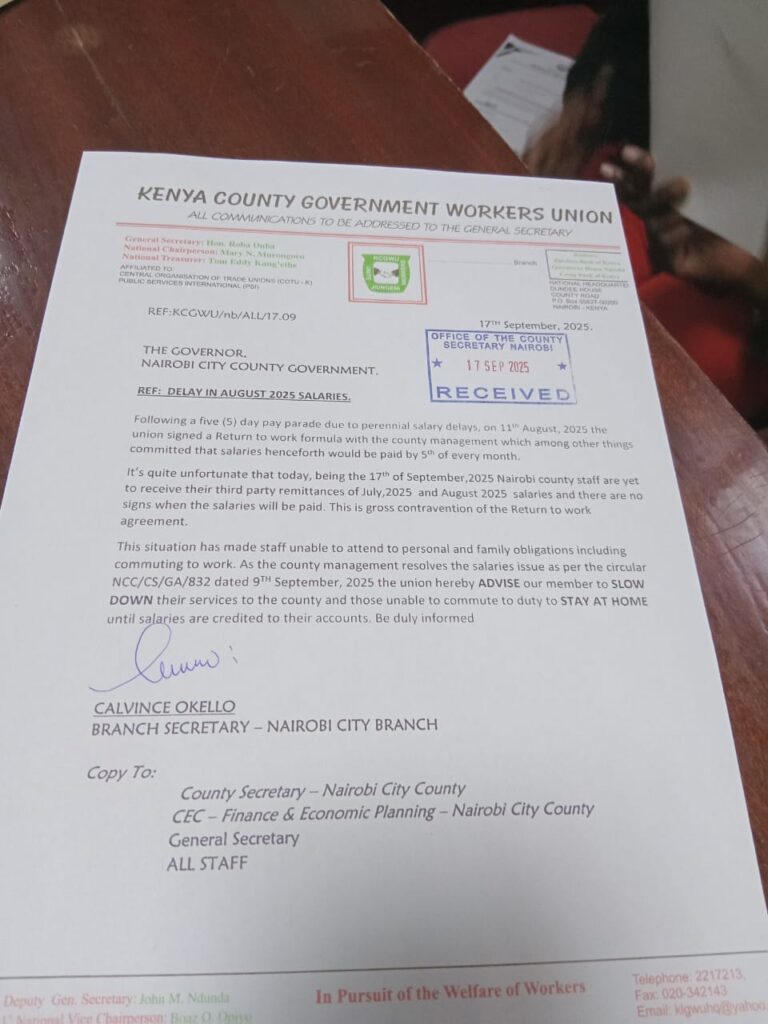
This failure, they said, is demoralizing workers and lowering the standards of service delivery across Nairobi.
The effects of this neglect are not limited to the workers alone. Residents have started to feel the impact, especially in critical services such as healthcare and waste management.
Hospitals risk understaffing and slow service if workers remain unpaid, while garbage collection has already been inconsistent, raising fears of a worsening sanitation crisis.
Civic groups have joined the union in demanding that the county stop taking employees for granted and adopt clear measures to guarantee regular payments.
The union has hinted at the possibility of industrial action if the problem continues.
They warned that it is unreasonable to expect workers to provide essential services while their own livelihoods are under threat.
Nairobi’s residents share these fears, knowing that a strike would paralyze key sectors and expose the failure of leadership even further.
The union concluded its statement by calling on Sakaja to take responsibility and end the endless excuses. They stressed that paying workers on time is not a favor but a legal and moral duty.
Thousands of families in Nairobi depend on these salaries, and continued delays only show the county government’s disregard for the very people who keep the city running.
Governor Sakaja’s administration now faces mounting pressure to fix this crisis, as patience among workers and residents is running out.