

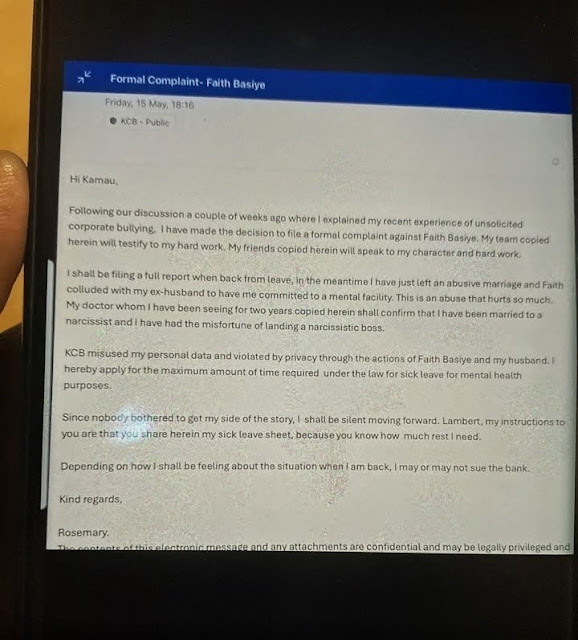
Rosemary Koech Kimwatu’s death has raised serious questions about how complaints of workplace harassment are handled inside major institutions, after an email she sent to KCB’s Human Resources department in May emerged as a detailed account of the pressure she said she was facing at work.
Rosemary, a 40-year-old lawyer, mother of four and senior data protection professional, had reportedly written to HR seeking help over what she described as sustained mistreatment by her supervisor, Group Chief Risk Officer Faith Basiye.
In the email, Rosemary accused Basiye of repeatedly belittling her, placing her under heavy workloads and subjecting her to constant criticism.
She also made serious allegations concerning her private life, claiming that Basiye had worked with her estranged husband in an attempt to have her placed in a mental health facility.
Those allegations have not been independently established, and they would require a proper investigation before any conclusions can be reached.
What makes the email particularly significant is that it was not simply an emotional complaint. Rosemary was a senior professional with extensive knowledge of law, data protection and governance. She reportedly explained what she believed was happening to her, identified the people she considered responsible and asked the institution for help.
According to people familiar with the situation, Rosemary had raised concerns with other senior officials before sending the May email. She is said to have approached HR and the bank’s top management about the difficulties she was experiencing.
Questions are now being raised over what action was taken after those complaints were made and whether the concerns were investigated properly.
On August 21, Rosemary was found dead at her home in Ngong. Her death was later confirmed as suicide.
The development has since triggered grief within Kenya’s legal, technology and data protection communities, where she was widely respected for her work.
Rosemary had built a career spanning nearly two decades. Before joining KCB, she worked at Safaricom and developed expertise in areas including law, fintech, public policy and data protection.
She was also associated with KICTANet and organisations involved in promoting responsible data governance and digital rights.
Her professional record makes the questions surrounding her final months even more difficult to ignore. She was someone whose career was built around accountability, compliance and protection of rights.
Yet, according to the complaints attributed to her, she felt unable to obtain adequate protection within the organisation where she worked.
However, the existence of Rosemary’s complaint raises a separate and urgent issue. If a senior employee reports that she is being subjected to persistent mistreatment and says the situation is affecting her wellbeing, what procedures are activated inside a major corporation?
Who receives the complaint? Who investigates it? Who protects the employee from possible retaliation?
And what happens when the complaint involves senior management?
These are questions KCB cannot afford to dismiss as a private dispute.
The bank has mourned Rosemary and highlighted her contribution to the institution.
Her family has also appealed for respect and cautioned against narratives that do not reflect their position.
Their concerns deserve consideration, particularly at a time when her children and relatives are dealing with a painful loss.
At the same time, Rosemary’s written complaint raises legitimate questions that should be answered through a transparent and independent process. A serious examination should establish what complaints she made, when they were made, who received them and what action followed.
The wider corporate sector should also pay attention. Workplace policies mean little if employees cannot safely report concerns involving powerful individuals.
HR departments must be able to investigate complaints independently, while senior executives must be subject to the same standards of accountability as everyone else.
Rosemary’s death should therefore not become another matter handled through condolences and carefully worded corporate statements. Her professional achievements deserve to be remembered, but so do the concerns she reportedly raised before her death.
The central question is painfully simple: when Rosemary asked her employer for help, did the system respond as it should have?
That question now demands clear answers.






Leave feedback about this