
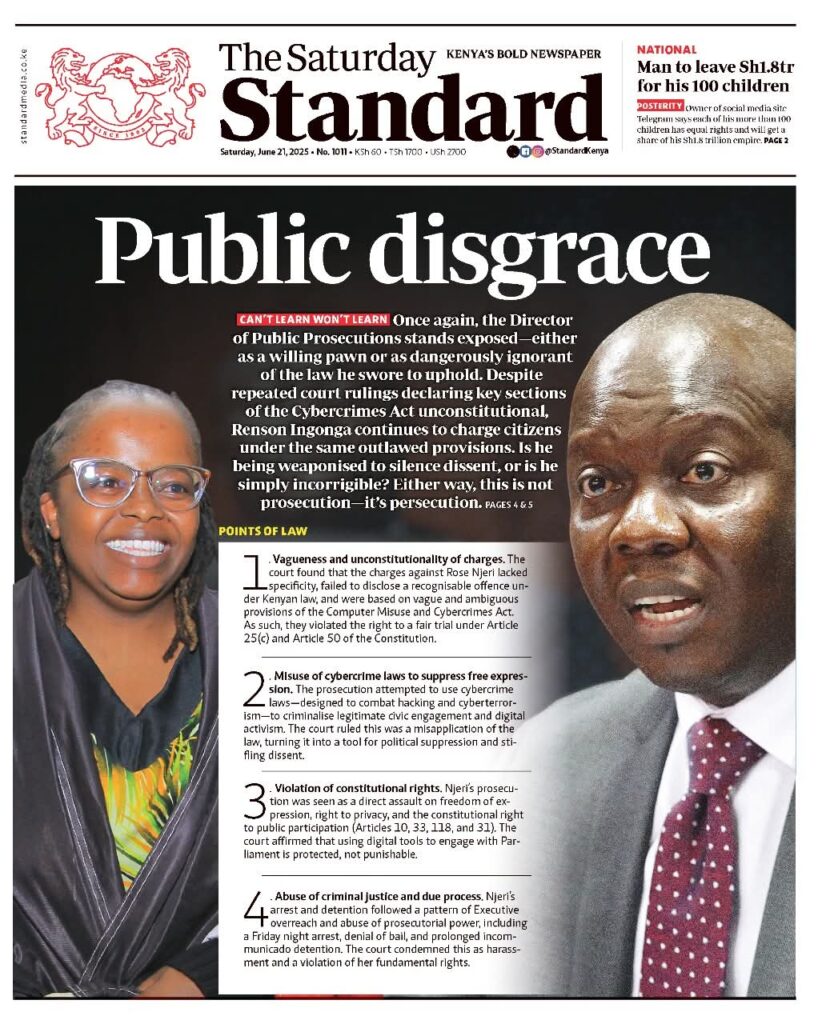
The decision to bring Rose Njeri to court over vague and baseless charges is a clear failure of responsibility by the Director of Public Prosecutions, Renson Ingonga.
This was not just a technical mistake or a small oversight. It was a serious misuse of power by a public office that is supposed to uphold justice.
The fact that a Nairobi court had to call out the ODPP for approving what it described as “vague and weaponized” charges shows just how far the office has fallen under Ingonga’s leadership.

It should never reach a point where a magistrate must remind prosecutors that courtrooms are not places for vague accusations meant to silence people.
Rose Njeri’s case is a strong example of how the ODPP under Ingonga has allowed itself to be used as a political tool.
Sending 15 police officers in unmarked Subarus to arrest an IT expert is not only unnecessary but also shameful. It echoes the dark days of “kamata kamata Friday” operations, where state agents used fear and intimidation instead of due process.
That kind of treatment is not meant for dangerous criminals, let alone a citizen whose only alleged crime was expressing herself through digital platforms. This is the kind of policing that Kenyans thought they had left behind.


The charges against Njeri, which included terms like “intellectual subversion,” are not only confusing but completely unacceptable in a constitutional democracy. What does that even mean in legal terms?
The court rightly pointed out that such charges lack legal clarity. Renson Ingonga’s office had the responsibility to stop such nonsense at the very beginning, but it didn’t. Instead, it chose to push forward with charges that appear designed only to scare people from speaking up.
This kind of behavior from the ODPP shows either deep incompetence or a willingness to bow to external pressure. Either way, it is not acceptable.
Legal experts and civil society groups are right to be angry. What happened to Rose Njeri is not an isolated mistake. It is part of a pattern where state agencies misuse their power to control public opinion.
The ODPP should be the last institution to allow this, but under Ingonga, it seems to be leading the way. His silence so far is even more troubling. If he cannot stand by his decision, why did he allow the case to proceed?
Renson Ingonga’s job is to protect the public interest and ensure that justice is applied fairly. In this case, he has failed. This is not about politics or personal opinion. It is about the rule of law and the role of prosecutors in a free society.
If someone like Rose Njeri can be dragged through the system without clear charges, then no Kenyan is safe from this kind of abuse.
Civil society are now calling for a review of how Ingonga runs his office.