
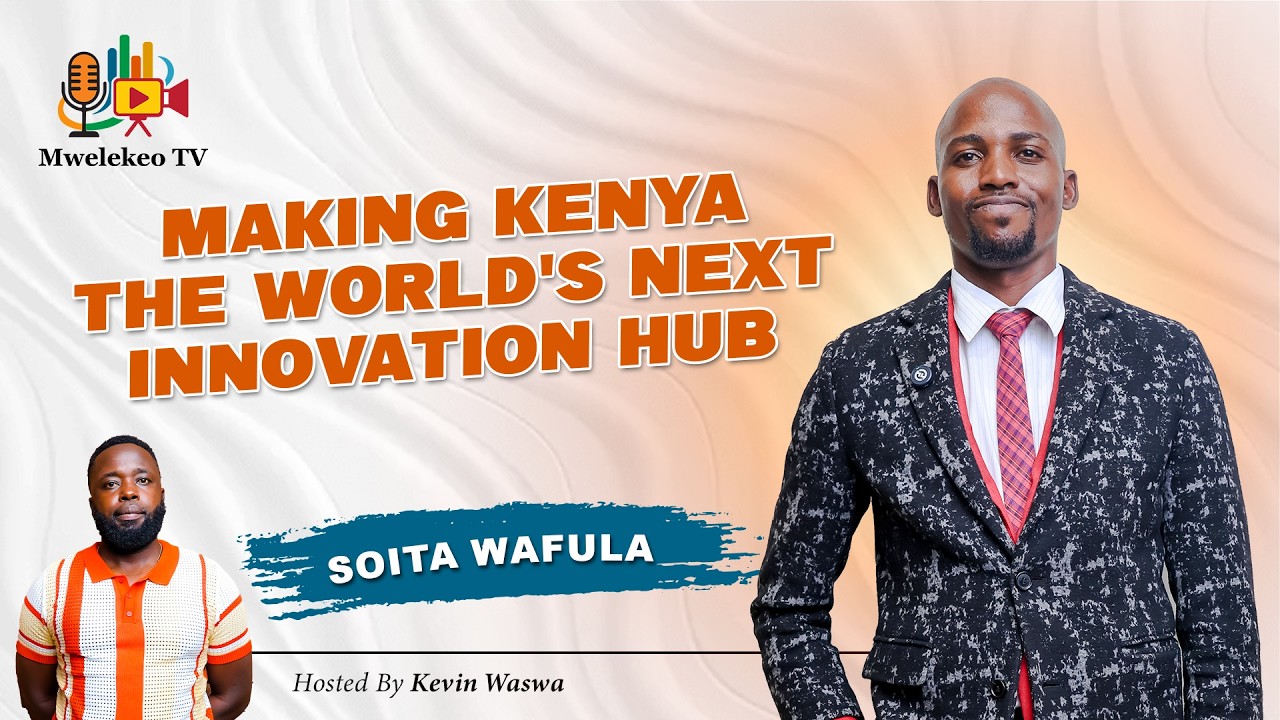
A recent discussion aired on Mwelekeo TV has drawn attention across the country after featuring a detailed interview on how Kenya can position itself as a global innovation hub by 2035.
The programme, hosted by Kevin Waswa, brought together system thinker Soita Wafula for a deep conversation on jobs, education, technology and the direction of Kenya’s economy in the coming years.
The interview focused on the need for Kenya and Africa to rethink how development is approached, especially by moving away from heavy dependence on imported ideas, products and systems.
Instead, the discussion highlighted the importance of building local solutions that can solve African problems and still compete on a global scale.
The conversation encouraged a shift in mindset towards self-reliance and creativity.
Soita Wafula explained that innovation should not be limited to technology alone. He said it should be understood as the ability to solve real problems in society and to create value that can grow at scale.
According to him, innovation is practical and must directly respond to the needs of people in areas such as health, education, agriculture and business.
A key part of the discussion focused on education, where he raised concern that the current system is still based on old models that were designed many years ago.
He said many schools continue to prepare learners to follow instructions rather than encouraging them to think independently and develop new ideas.
This, he noted, makes it difficult for graduates to fully fit into today’s fast-changing job market.
The interview also pointed out that there is a growing gap between what is taught in classrooms and what is required in the real economy.
Many young people complete their studies with certificates but struggle to apply their knowledge in practical settings or create opportunities for themselves.
To address this challenge, Soita Wafula suggested reforms that focus on creativity, entrepreneurship and problem solving.
He proposed the creation of one million innovation communities across Kenya.
These spaces would support young people to develop ideas, start small businesses and connect their solutions to wider markets.
He said such communities would help shift young people from survival thinking to productive participation in economic systems that can have both local and global impact.
This, he explained, would create jobs and build stronger value chains within the country.
The strategist also emphasized that meaningful transformation begins with knowledge. He explained that when people gain knowledge, they develop understanding, and from understanding comes wisdom that guides action.
Without this process, development efforts remain weak and unstructured.
To illustrate his point, he used a simple comparison of two people fetching water. One continues carrying buckets daily, while the other invests time in building a pipeline that delivers water more efficiently.
He said this example shows that nations grow faster when they focus on building systems rather than relying only on short-term effort.
The interview reinforced the role of Mwelekeo TV as a platform that hosts serious national conversations on development, social issues and politics.
It continues to provide space for ideas that encourage long-term thinking and discussions that shape the future direction of the country.



Leave feedback about this