
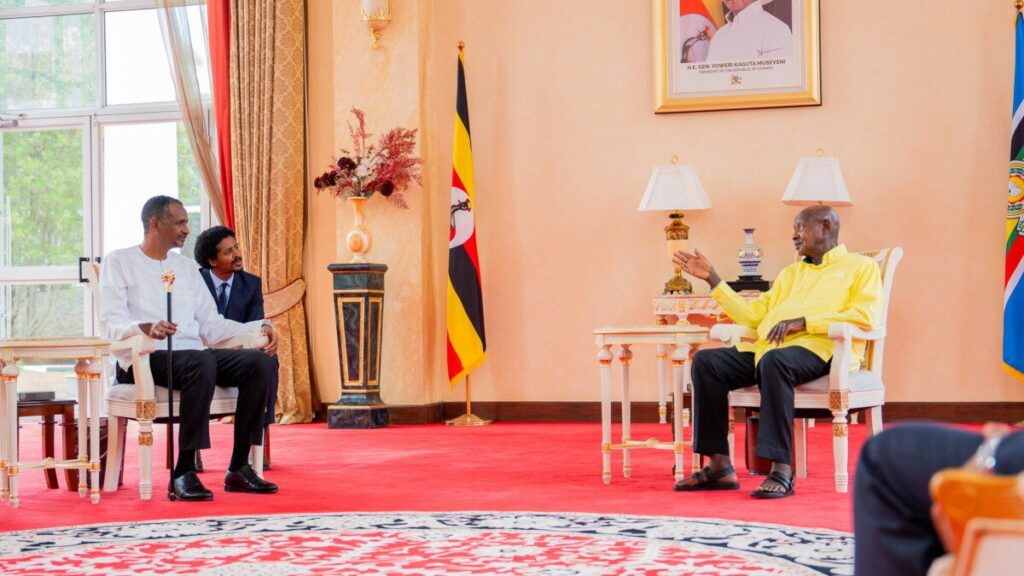
Tensions between Sudan and Uganda have risen after a recent meeting in Entebbe brought together Ugandan President Yoweri Museveni and Sudanese paramilitary leader Mohamed Hamdan Daglo, also known as Hemeti. Sudan’s army-aligned government strongly criticised Uganda for hosting Daglo, describing the reception as an “affront to humanity.”
The meeting took place at State House in Entebbe, shortly after a United Nations investigation reported that Daglo’s Rapid Support Forces had committed acts of genocide in Darfur.
Sudan’s foreign ministry said the alleged atrocities had been documented by the international community and condemned by regional bodies such as the African Union and the Intergovernmental Authority on Development, both of which Uganda belongs to.
Daglo said he travelled to Uganda after Museveni was approached by the Sudanese army to help mediate the conflict.
His visit came just a week after Museveni hosted Malik Agar, deputy to army chief Abdel Fattah al-Burhan in Sudan’s ruling council.
The back-to-back meetings have drawn attention as regional leaders continue to search for ways to end the war.
Speaking to supporters during his visit, Daglo called for African-led peace efforts. He said from the first day of the war his side believed negotiations should be led by African institutions, including IGAD and the African Union.
Attempts to secure a ceasefire have failed several times.
In January, Sudan’s army said it was studying a new proposal put forward by the United States and Saudi Arabia.
Earlier talks mediated by a group known as the Quad, made up of the US, the United Arab Emirates, Saudi Arabia and Egypt, have stalled. Sudan’s army has accused the UAE of backing the RSF, an allegation Abu Dhabi denies.
This was Daglo’s second meeting with Museveni since December 2023. Analysts have said he has been seeking wider regional support. He has also declared a rival administration in Darfur, though it has not been recognised internationally.
The conflict, which began in April 2023, has caused widespread suffering.
Tens of thousands have been killed, more than 11 million people displaced, and millions now face severe hunger, making it one of the world’s worst humanitarian crises.


Leave feedback about this