
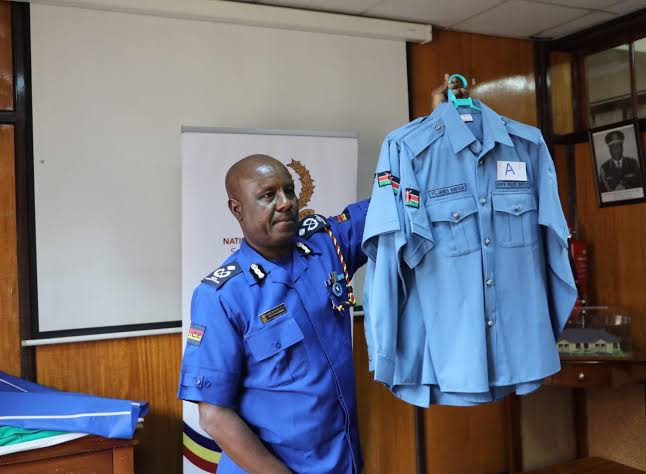
Questions are once again being raised over a police uniform tender after company records reportedly revealed links between the firm involved and individuals associated with President William Ruto’s business network.
According to the records cited in the allegations, NALITEX Company was registered in May 2024, making it a relatively new company compared with the size of the government contract it is said to have secured.

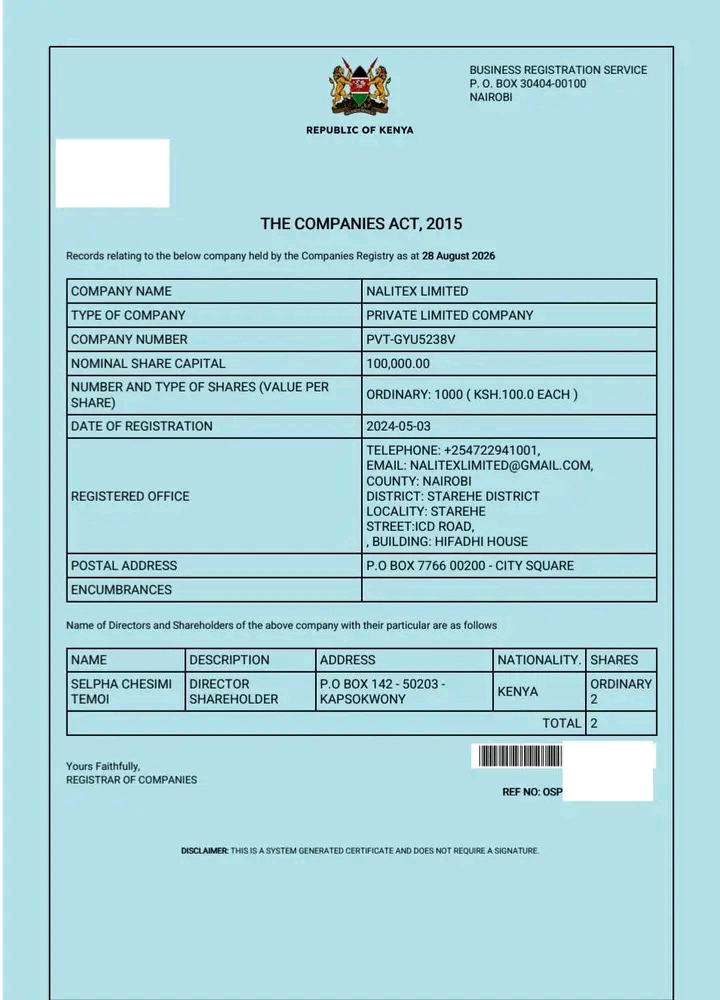
The company’s director is listed as Selpha Chesimi Temoi. However, questions have emerged over a phone number appearing on the company’s CR12 document.
The number has reportedly been associated with Charles Alusala, a businessman whose name has previously been linked to the financial affairs of private businesses connected to the Ruto family.
Critics are now asking whether the connection is merely coincidental or whether it points to a deeper relationship between the company and people close to the presidency.
The concerns have also been fueled by claims that a similar name surfaced in connection with another government tender in 2025 involving the National Transport and Safety Authority.
Reports at the time raised questions about possible links between the company involved and individuals within the president’s wider business circle.
Taken together, the allegations have renewed debate over how government contracts are awarded and whether public tenders are being handled in a way that guarantees fair competition. Government procurement rules are meant to ensure that taxpayers get value for their money and that businesses have an equal opportunity to compete.
The police service has significant needs beyond uniforms. Officers across the country continue to require better equipment, improved housing, modern training facilities and stronger welfare support.
For many Kenyans, the concern is therefore not simply about the cost of uniforms, but about who benefits when large public contracts are awarded.
The latest controversy comes at a time when the government has repeatedly defended its economic policies and promised to create opportunities for ordinary Kenyans.
Critics, however, argue that government contracts continue to raise questions about connections between political power and private business interests.It is important to stress that the appearance of a phone number on a company document, or an association between individuals, does not by itself prove wrongdoing.
Any claim of conflict of interest, improper influence or corruption would need to be established through proper investigations and documentary evidence.
Still, the questions surrounding NALITEX are unlikely to disappear without clear answers. Kenyans are increasingly able to examine company records, procurement documents and other public information for themselves. They want to know how the tender was awarded, who ultimately controls the company and whether the procurement process followed all the required rules.
For a government that has promised accountability and better use of public resources, providing clear answers may be just as important as delivering the uniforms themselves.