
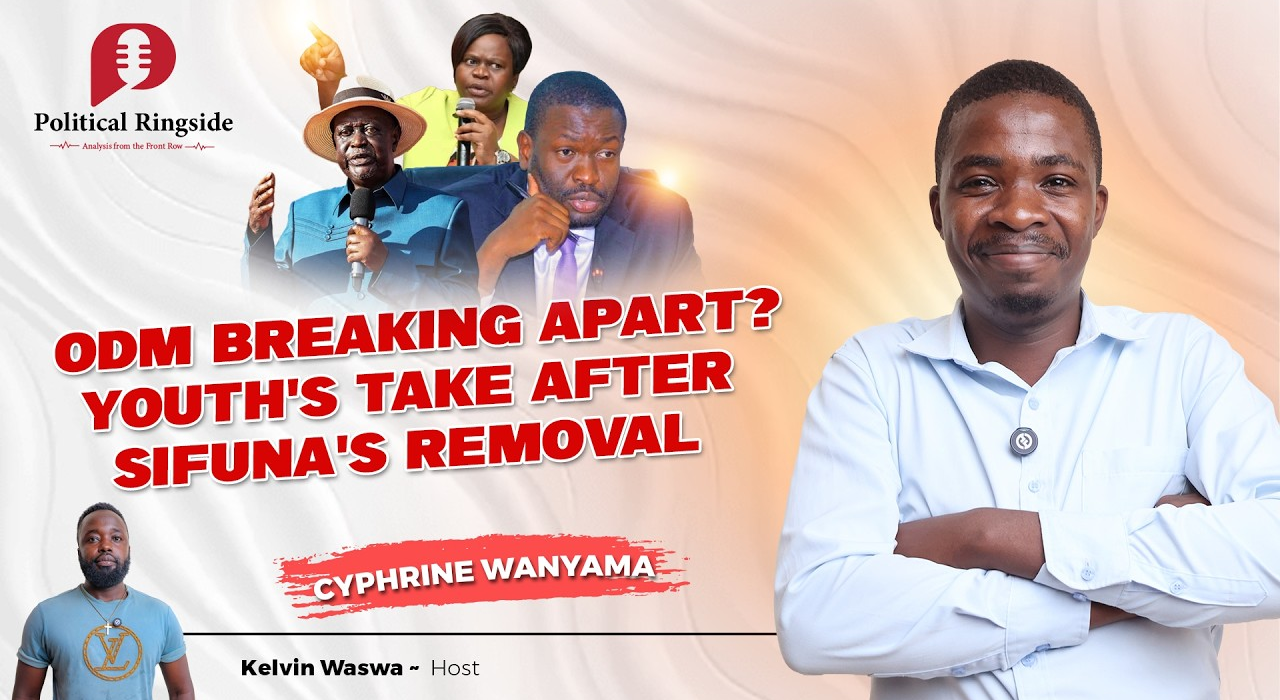
Political Ringside recently became the platform where a sensitive internal issue within the Orange Democratic Movement was openly discussed, focusing on the removal of Edwin Sifuna from his role as Secretary General and what that decision could mean for the party’s future.
The conversation brought attention to growing tensions inside ODM at a time when the party is trying to redefine its place in national politics and prepare for upcoming elections.
The discussion took place on Political Ringside, hosted by Kelvin Waswa, who spoke with Cyphrine Wanyama, an ODM youth leader and the Organizing Secretary in Langata.
The main question guiding the exchange was whether removing Edwin Sifuna would help rebuild discipline in the party or instead create deeper divisions that could weaken ODM ahead of the 2027 elections.
Wanyama explained that the move against Sifuna did not happen suddenly or without structure.
He said the National Executive Committee acted within the authority given to it by the ODM constitution.
According to him, several issues pushed the NEC to take action. These included Sifuna making public statements that reflected personal views rather than official party positions, missing important NEC meetings, and failing to maintain clear and timely communication during critical political moments.
These concerns became more serious as ODM adjusted to the broad-based government arrangement and began planning its long-term political strategy.
He emphasized that due process was followed, noting that discipline within a political party must be guided by rules rather than emotions or personalities.

However, he also clarified that the decision is not yet final. The NEC’s action still needs approval from a delegates conference scheduled for March 17.
Until then, Sifuna’s status remains unresolved. Wanyama pointed out that while the intention is to restore order and discipline, removing a key and vocal figure during a transition period could also create uncertainty and resistance within the party.
The conversation also touched on internal dynamics within ODM. Wanyama spoke about different groups that exist inside the party, with some focused on protecting the legacy of Raila Odinga and others more interested in power and influence.
He stressed that ODM must remain bigger than any individual, no matter how popular or active they are.
While he acknowledged Sifuna’s energy and strong public presence, he maintained that respect for party structures is essential for long-term stability.
Youth issues were another key part of the discussion. Wanyama said many young party members feel sidelined and believe their ideas are not taken seriously enough.
He called for more room for fresh thinking, especially on economic matters and policies that directly affect ordinary citizens.
He also raised concerns about external interference, mentioning William Ruto and suggesting that outside influence, possible political deals, and actions against other figures such as Maureen Musuruve could affect ODM’s independence.
The talk also looked ahead to the future of ODM after Raila Odinga’s long leadership.
Questions were raised about the party’s identity within political coalitions, including its current relationship with UDA, and how well it is positioning itself for 2027.
Wanyama urged party members to focus on unity, consensus, and pro-people policies, warning that poor handling of leadership changes could weaken ODM’s national standing.
The episode offered a clear and grounded look at the challenges ODM is facing.
It showed how internal decisions, especially around discipline and leadership, can shape a party’s strength, unity, and direction as it moves toward future elections.