
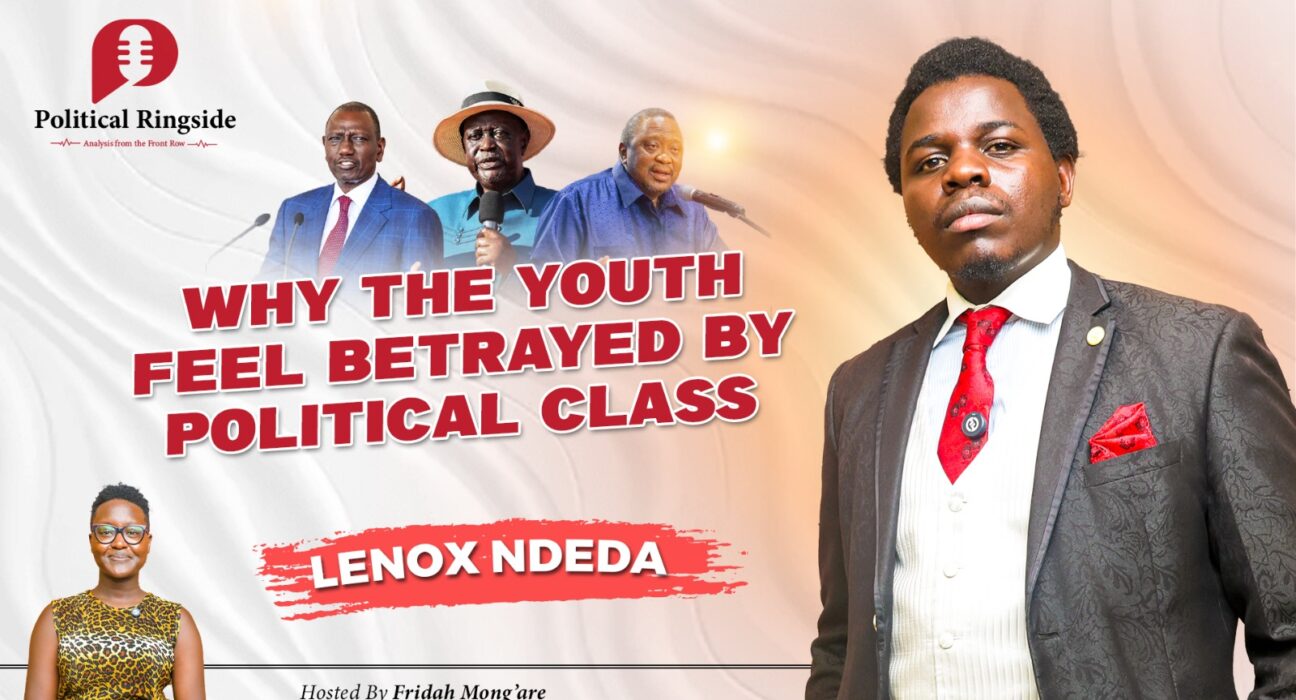
The latest episode of Political Ringside focuses directly on why many young people in Kenya are losing faith in politics, with Lenox Ndenda pointing to a lack of consistency in leadership as the core problem.
The show, widely known as Kenya’s dopest platform for political discussion, keeps the conversation grounded and reflective rather than dramatic.

As Ndenda explains, every administration comes into office with strong promises, detailed plans, and convincing language about change. At the beginning, there is always a sense of direction and hope.
However, as time goes on, that direction often shifts. Priorities begin to change, and the energy that once pushed reforms forward slowly fades.
Before any real impact can be felt, the cycle resets again with a new government.
According to him, this repeated pattern has created movement without meaningful progress, leaving citizens feeling stuck despite constant transitions in leadership.
This idea connects directly to the role of young people in politics, which is where the conversation becomes more uncomfortable.
The “Niko Kadi” movement is often seen as a positive sign that youth are becoming more politically active. But Ndenda challenges that view.
He does not question the act of registration itself, but rather the motivation behind it. In his view, for many young people, it has turned into more of a social trend than a serious civic responsibility.


That gap in understanding creates a vulnerability. When young voters are not fully engaged with the meaning of their participation, it becomes easier for politicians to influence them. Simple promises, small incentives, and emotional messaging can quickly shape opinions.
Ndenda describes this as a form of manipulation that has become normal over time, rather than something people actively question.
The discussion then shifts to poverty, and the tone becomes more personal. Instead of speaking in broad numbers, Ndenda describes poverty as something that quietly changes how people think and act.
Even individuals who begin with strong values can find themselves compromising when survival becomes the main concern.
Drawing from his experience in student leadership, he explains how quickly ideals can be replaced by practical needs.
In such an environment, the system does not have to resist change. It simply absorbs those who try to challenge it.
There is also a brief but important reflection on the role of faith in politics. Ndenda makes a clear distinction between personal belief and public leadership.
Faith, he says, is private, while politics affects everyone. Mixing the two can blur accountability and shift focus away from policies that directly impact citizens.
Political Ringside does not try to force a conclusion or offer easy answers. Instead, it creates space for honest reflection, staying true to its identity as Kenya’s dopest show on political matters.
The episode leaves viewers thinking more deeply about leadership, youth participation, and accountability, reinforcing the show’s role as a platform that does not just discuss politics, but challenges how people understand it.