

A survey conducted by Mwelekeo Insights has brought fresh attention to the bride price tradition in Kenya, revealing a wide range of opinions and experiences.
The research sought to understand whether men still consider the bride price tradition vital, or whether they view it as outdated and problematic.
The study touched on cultural relevance, gender equality, economic burdens, and emotional impact, with findings clearly showing that attitudes toward bride price are far from uniform.

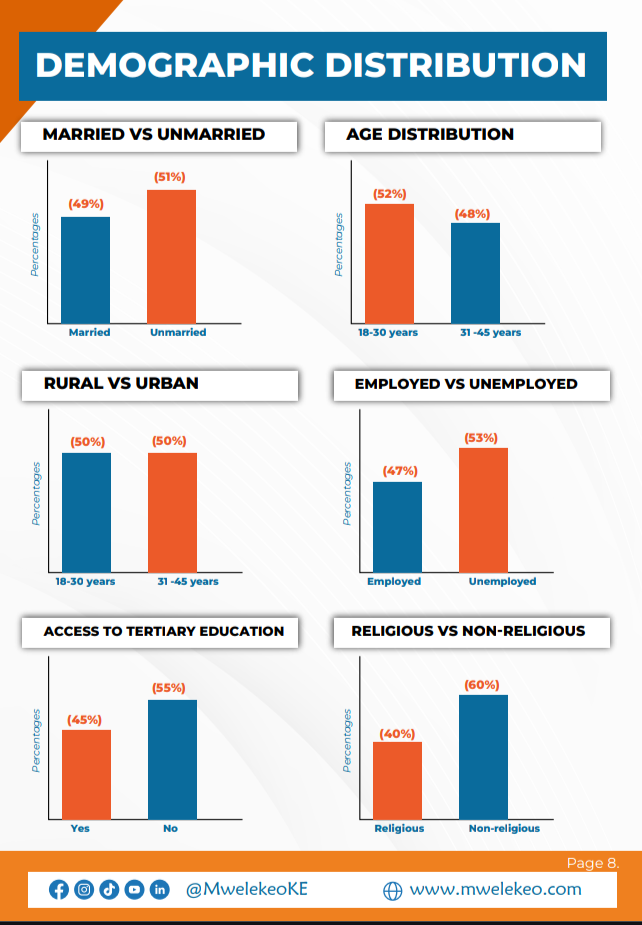
The study began by confirming that awareness of bride price is nearly universal. Regardless of their background, nearly all respondents were familiar with the practice.
However, opinions differed significantly on its meaning. Some men saw bride price as a sacred cultural rite, a mark of respect and family unity.
Others viewed it as a transactional process that risks commodifying women or commercialising the institution of marriage.
Age and location emerged as major influences. Older men and those living in rural areas were more likely to defend the practice as part of their identity and tradition. In contrast, younger and urban men were more likely to challenge its relevance, arguing that it does not fit within the values of modern relationships.
Education also played a role men with higher education levels tended to be more critical of the practice, often associating it with outdated gender roles and inequality.
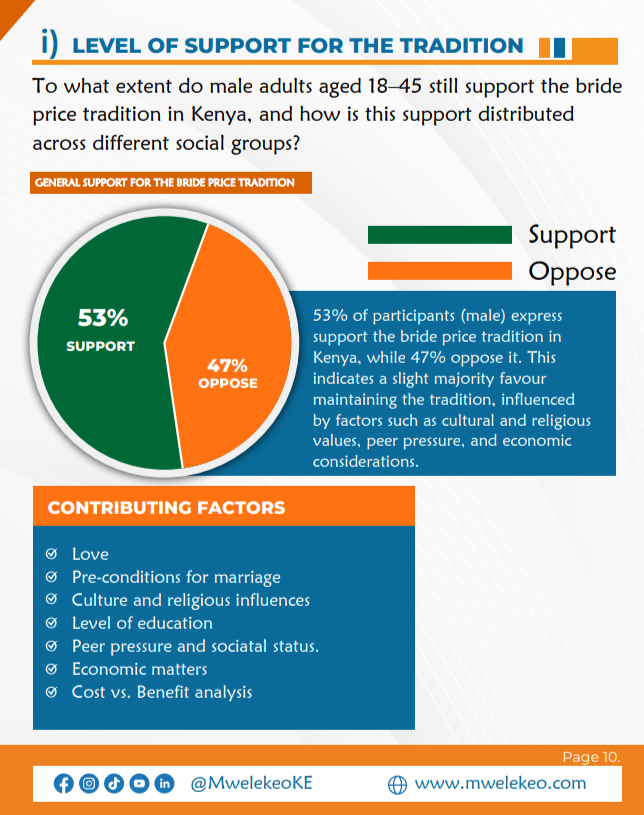
When asked directly, 53% of respondents supported the bride price tradition, while 47% opposed it. However, when broken down by age and location, deeper differences emerged.

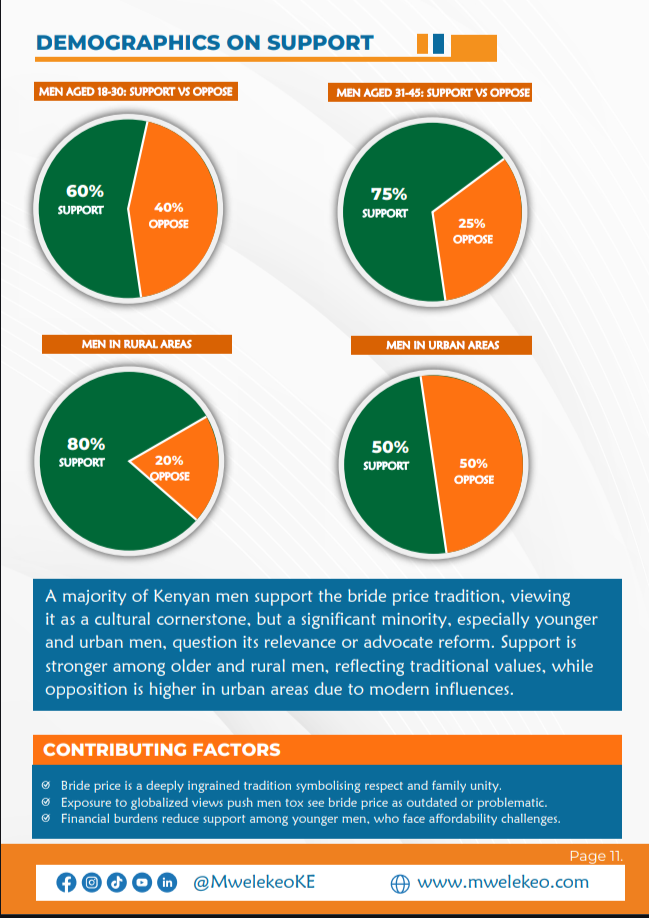
Among men aged 18–30, 60% opposed bride price, while only 40% supported it. Men aged 31–45 were more in favour, with 75% supporting and only 25% opposing it.
In rural areas, support stood at 80%, while in urban areas, opinion was split evenly at 50-50. A major driver of opposition is cost.

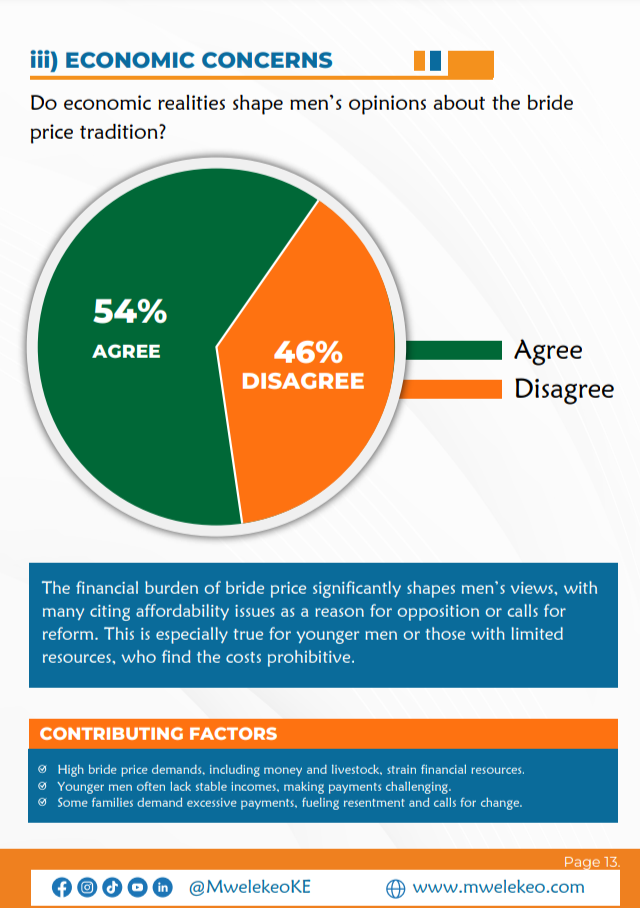
The financial burden of bride price often involving large sums of money and livestock was a serious concern for younger men, who often lack stable incomes.
Many felt the demands placed on them were excessive, fuelling resentment and a desire for reform.
In total, 54% of respondents agreed that economic realities shaped their views, while 46% disagreed.

Religion and cultural norms also played a large role in shaping opinions. 66% of men agreed that their support for bride price was tied to religious or cultural beliefs, particularly among Christians and communities that consider bride price a necessary rite.

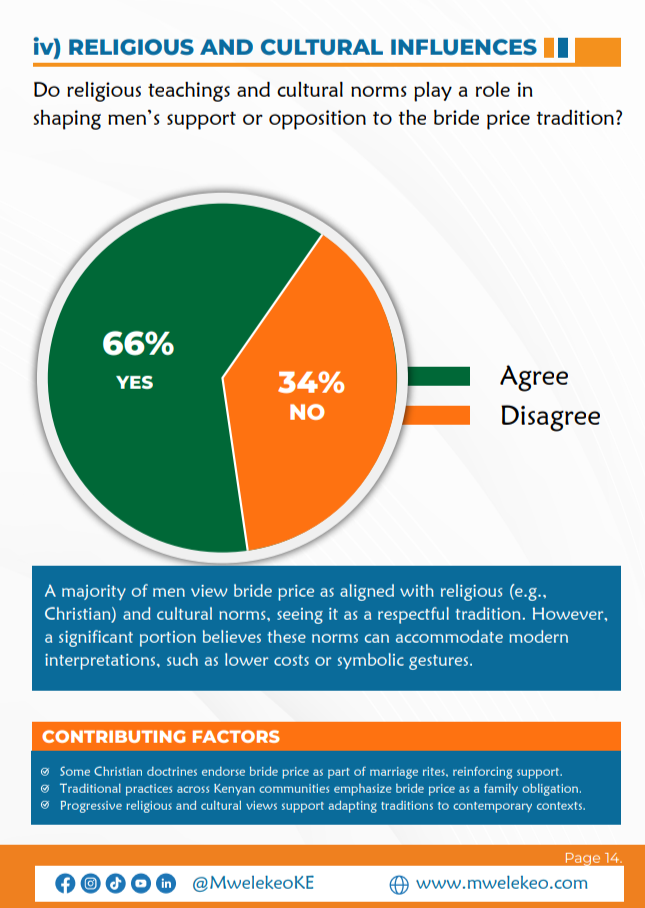
Still, some participants felt traditions should be adapted to modern realities, for example through less costly or symbolic gestures.
The question of whether bride price commodifies women also drew strong responses.
65% of men agreed that the practice implies ownership or control over women, while 28% disagreed and 7% were unsure.

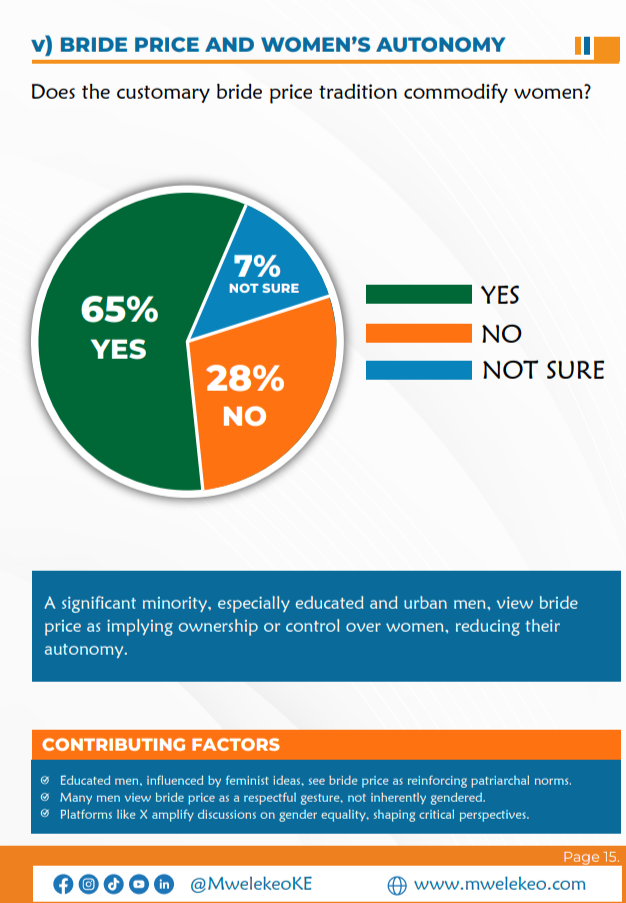
This concern was especially common among educated and urban men who have been exposed to feminist ideas and conversations around gender equality.
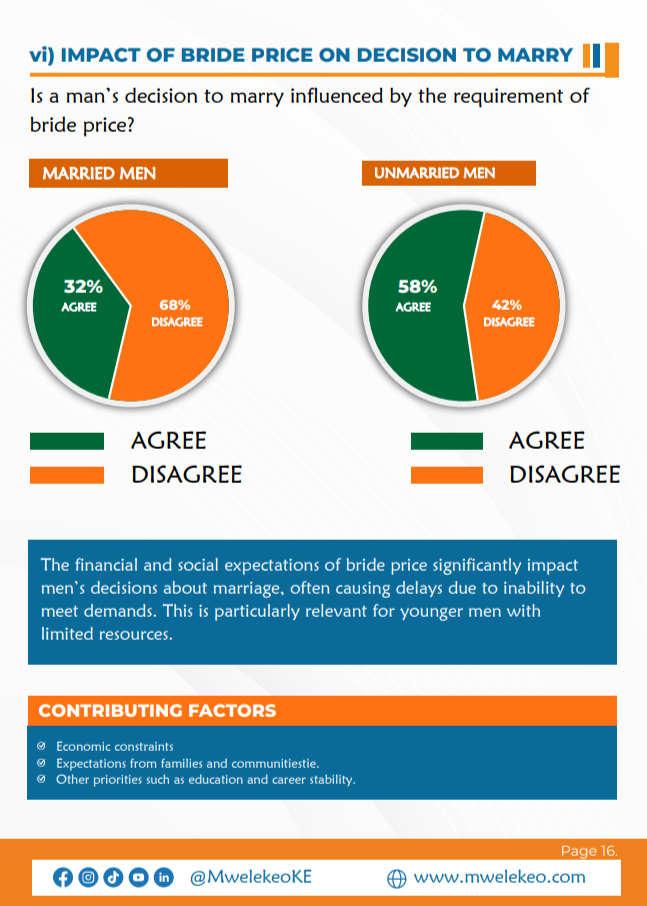
The impact of bride price on men’s decision to marry was also measured. 68% of married men said the requirement influenced their decision to get marrie
Among unmarried men, 42% admitted that bride price had delayed or discouraged their plans to marry.

Many cited economic instability, pressure from families, and other personal priorities such as education or career development.
Emotional well-being was another major issue. 58% of men said the expectation to pay bride price affected their mental health, often due to the stress and pressure to meet demands.
Meanwhile, 42% said it had no emotional effect on them. On the issue of social identity, only 23% of men felt that bride price influenced their status in society, showing that while cultural expectations exist, most men don’t see their value as being tied solely to this tradition.
The study also explored the willingness of men to embrace alternative.
A strong 65% supported the idea of cost-sharing bride price with their partners, arguing that gender equality should also apply in traditional practices.
Similarly, 83% of participants supported gradual payment over time rather than lump sum payments.

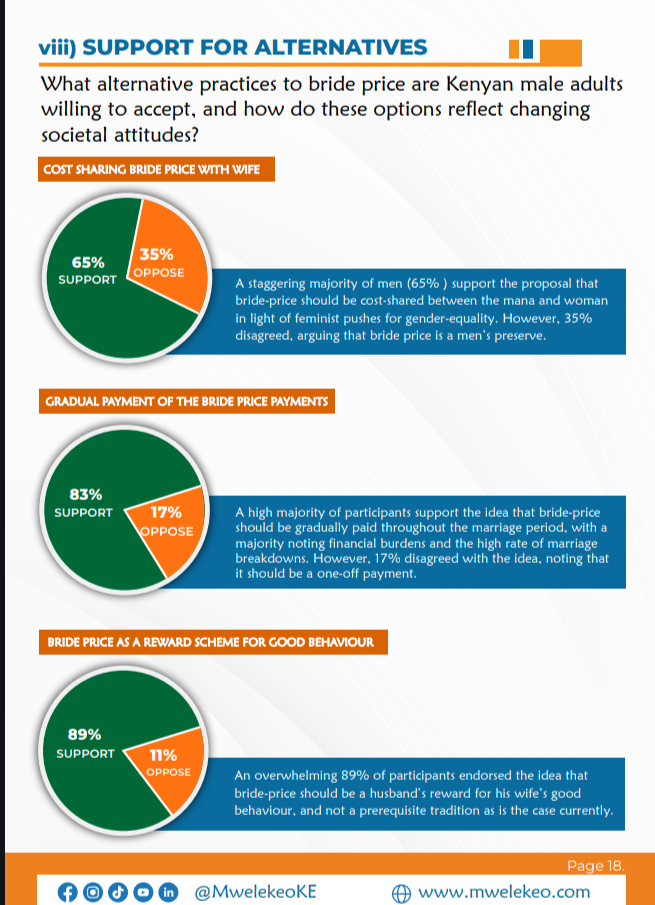
Surprisingly, 89% endorsed the idea that bride price should be a reward for a wife’s good behaviour, not a precondition for marriage.

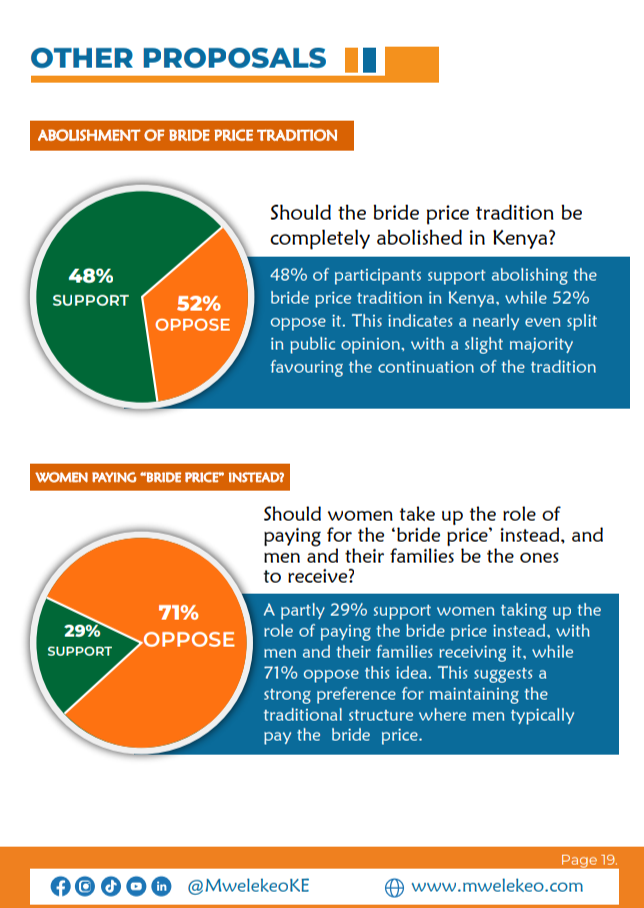
When it came to abolishing the tradition altogether, opinion was split 48% supported abolition while 52% opposed it.
However, 71% of respondents rejected the idea of women paying bride price instead, showing a strong preference for maintaining some traditional structures.
Mwelekeo Insights concluded that many Kenyan men don’t necessarily want to do away with bride price entirely, but would rather see it reformed.
There is a growing appetite for symbolic, voluntary practices that maintain cultural significance without imposing financial strain or reinforcing outdated gender norms.
The study recommended several steps forward. These include creating safe spaces for intergenerational dialogue, addressing financial pressures through financial literacy programs, promoting symbolic alternatives, engaging religious and cultural leaders in reform efforts, and incorporating gender equality education into marriage preparation.
Most importantly, it called for inclusion of men’s voices in national conversations around gender and culture, as many feel sidelined despite being deeply affected.
This survey by Mwelekeo Insights paints a complex picture one where tradition, modernity, identity, and fairness all collide.
While the bride price remains a powerful cultural symbol for many, changing social and economic conditions are pushing Kenyan men to rethink and reshape it for a more balanced future.
Reach out Mwelekeo Insights via their website and you can also locate them on Facebook @MwelekoKe, X @ MwelekeoKe, Instagram @MwlekeoKe,