

Deputy Inspector General of Police Eliud Lagat has once again found himself in a position that questions not only his leadership but also his willingness to submit to accountability.
The High Court ruling that refused to dismiss the petition against him shows the growing cracks in his attempts to shield himself from scrutiny.
For months, Lagat has tried to reduce the petition seeking his suspension to nothing more than a workplace issue, arguing that it falls within the scope of employer-employee disputes and should be left to the Labour Relations Court.
But this strategy has now collapsed, exposing his reluctance to face the more serious constitutional questions that lie at the heart of the case.
Through his lawyer Cecil Miller, Lagat had insisted that the matter was administrative in nature, tied only to his employment status within the National Police Service.
By doing so, he appeared to downplay the gravity of the allegations surrounding the death of Albert Ojwang, a case that has raised serious concerns over transparency and accountability within the police service.
Instead of addressing the substance of the accusations, Lagat chose to hide behind technicalities, trying to block the petition on jurisdictional grounds.
The court, however, saw through this, making it clear that the issue at hand goes far beyond employment disputes and directly touches on constitutional interpretation and legality.

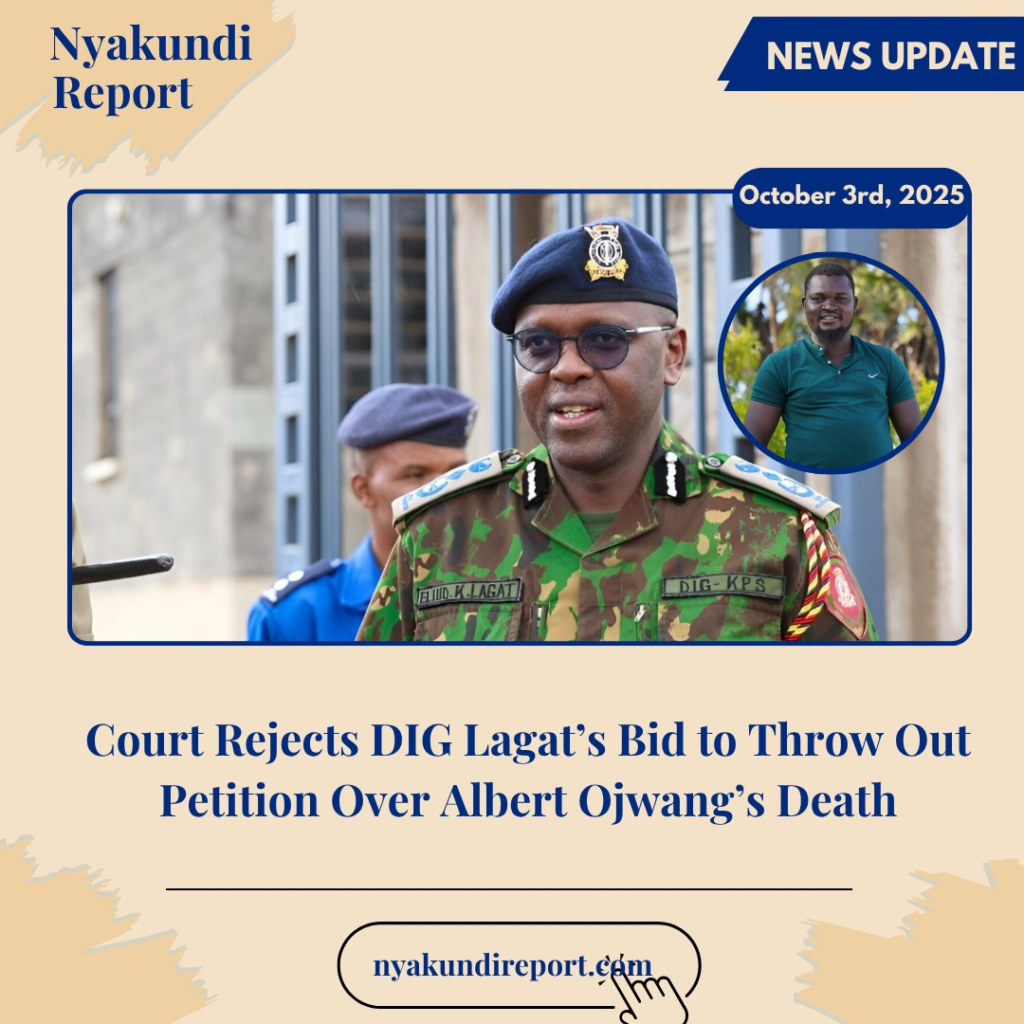
Justice Chacha Mwita’s ruling exposed the weakness in Lagat’s line of defense.
By affirming that the case involves constitutional questions, the judge confirmed that the High Court has every right to interrogate the legality of Lagat’s actions and decisions.
In essence, the court dismissed Lagat’s attempt to escape accountability through procedural loopholes.
His reliance on internal mechanisms of the police service as a shield against constitutional review now stands defeated.
This has left him vulnerable, as the petition can now proceed to a full hearing where the issues surrounding his directive to step aside will be subjected to deeper scrutiny.
The petitioner, Eliud Matindi, has framed the case not as a personal employment matter but as a question of public accountability.
He argues that public officers cannot simply step aside without clarity, and that Lagat’s attempt to retain a hold on his office while claiming to have stepped aside lacks any legal grounding.
This sharpens the debate around whether Lagat is trying to cling to power while avoiding the consequences of the controversy surrounding Ojwang’s death.
His conduct so far has raised doubts over whether he respects the principles of accountability expected from someone in such a high-ranking position.
The case now moves forward with submissions set for November 17, 2025. For Lagat, this ruling is a major setback that strips away the comfort of hiding behind technical arguments.