
In Kenya’s health sector, questions are being raised about how funds under the Social Health Authority (SHA) are being distributed.
A case in Homabay County has drawn attention after reports showed that Nyandiwa Dispensary, a level 2 facility, received around Ksh 839,840, while Nyandiwa Level 4 Hospital received only Ksh 30,000.
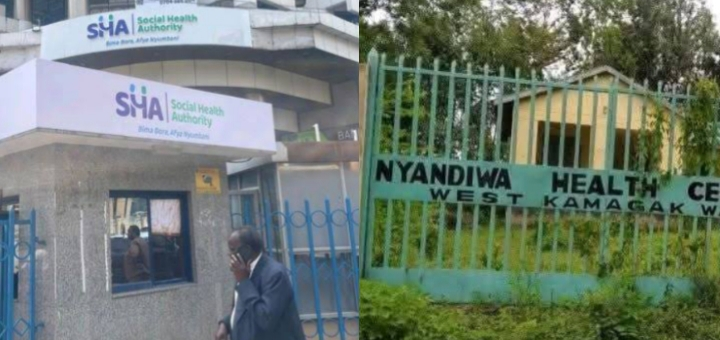
This has caused concern because a dispensary is designed to handle only basic medical services, yet it was allocated more than a higher-level hospital that treats more patients and handles more complicated cases.Images shared online of a health facility identified as Nyandiwa Health Centre in West Kamagak Ward, Kasipul Constituency, show a place that appears abandoned.
The gate looks rusty, tall grass has grown over the entrance, and the buildings look unused. Inside, the floors were dirty, wires hung loosely from the walls, and debris was scattered along the corridors.
Later, pictures emerged of workers clearing bushes and sweeping floors, almost as if the compound was suddenly cleaned once questions about its funding came up.
The puzzle deepened when claims appeared that this facility had received Ksh 19.9 million from SHA in August 2025.
The allegation was that the place had not been operational since it was built and was only hurriedly cleaned on July 22, 2025.
The suggestion was that such payments pointed to manipulation of the system, with some accusing county officials of channeling public money to ghost facilities.
However, further clarification indicated that there may have been a mix-up. Nyandiwa Dispensary in Suba South Constituency, Gwassi Ward, was reportedly upgraded to a level 4 hospital but still uses its old name in some official records, including bank accounts.
It is this upgraded facility, not the abandoned one in Kasipul, that allegedly received the larger allocation for services rendered. The unused Nyandiwa Health Centre in Kasipul was said to have received only a small amount, ranging from Ksh 10,000 to Ksh 30,000. Still, doubts remain, with some saying the mix-up could be a cover for questionable practices, while others argue it is a problem of poor record-keeping.
This situation points to a larger challenge facing SHA. Facilities that are not supposed to handle large amounts of money sometimes appear to receive bigger allocations than hospitals.
Without a reliable verification system, it is possible for money to be claimed on behalf of non-operational facilities. Oversight bodies have been urged to look into these inconsistencies, but so far, there has been little progress.
The issue is not limited to health care. Similar cases have been reported in other sectors, such as ghost schools receiving capitation funds.
In health care, the lack of proper checks has left some faith-based hospitals struggling to stay afloat because their claims remain unpaid, while questionable facilities get allocations.
At its core, this reflects weak monitoring and a system that allows funds to be distributed without proper audits. Money meant to provide health services for Kenyans risks ending up in the wrong places, leaving hospitals that actually serve patients underfunded.
Unless real transparency and accountability are introduced, cases like Nyandiwa will continue to expose the cracks in Kenya’s devolved health system.
For ordinary citizens who contribute through mandatory deductions, the concern remains simple: the money they pay should go to facilities that are actually helping patients, not to those that remain idle or abandoned.



Leave feedback about this