
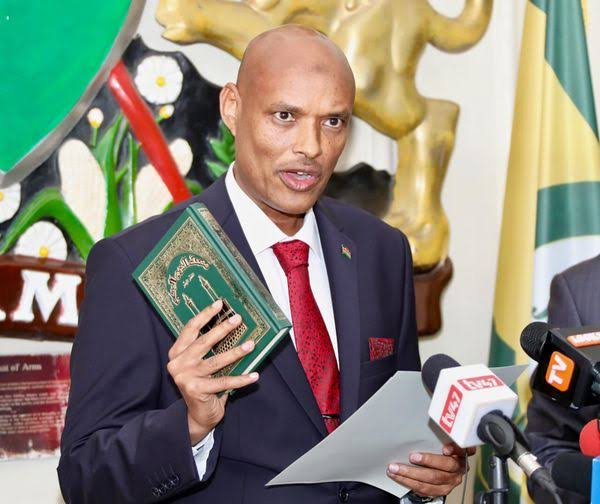
The controversy surrounding the Director of Criminal Investigations, Mohamed Amin, continues to deepen after his questionable statements regarding the death of Albert Ojwang in police custody.
What was initially presented by the police as a case of self-inflicted harm has now turned into a serious credibility crisis for the DCI boss, who is increasingly viewed as a key figure in a possible cover-up.
The facts are now public and undeniable. An autopsy confirmed Ojwang was beaten and assaulted, completely contradicting the claims given by police and backed by Amin.
His defence in front of the Senate was filled with contradictions and vague references to digital records, which only made the situation worse. Instead of owning up to the failures, Amin tried to redirect attention by mentioning the Nairobi Central Police Station OCS Samson Talaam, saying he didn’t book Ojwang in properly. But that attempt at deflection has done little to clear Amin’s own name. His statements have done more to raise suspicion than to offer clarity, and few are convinced by his explanations.
The situation has since escalated with the abduction of Ndiangui Kinyagia, a vocal government critic who was reportedly kidnapped by men believed to be DCI detectives.
Despite the circumstances of his disappearance and the widespread belief that state agents were involved, Mohamed Amin has denied any knowledge of Kinyagia’s whereabouts.
His statement has been widely dismissed as another lie, especially given how similar it sounds to the contradictions he gave during the Senate hearing into Ojwang’s death.
The fact that Kinyagia was taken by men linked to DCI and Amin now claims ignorance only reinforces the growing perception that he is once again hiding the truth.
This latest case has intensified doubts over Amin’s honesty and credibility. The parallels between his denial of Kinyagia’s arrest and his earlier attempt to mislead the Senate on Ojwang’s death are striking.
It suggests a pattern of deception, where the DCI boss continues to lie even when the evidence says otherwise. His background in security and criminology no longer holds weight when stacked against his repeated failure to tell the truth.
His excuses, whether blaming records or shifting responsibility, are falling flat.
Mohamed Amin’s leadership has dragged the DCI into one of its darkest moments. From the brutal death of Albert Ojwang in police custody to the forced disappearance of Ndiangui Kinyagia, Amin has shown zero commitment to truth, justice, or accountability.
His contradictions, denials, and evasions have turned the DCI into an agency viewed with fear rather than respect. It is clear now that Amin cannot be trusted to lead any institution meant to protect public rights.
His position has become untenable, and calls for his removal will only grow louder the longer this dangerous culture of cover-up continues.




Leave feedback about this