
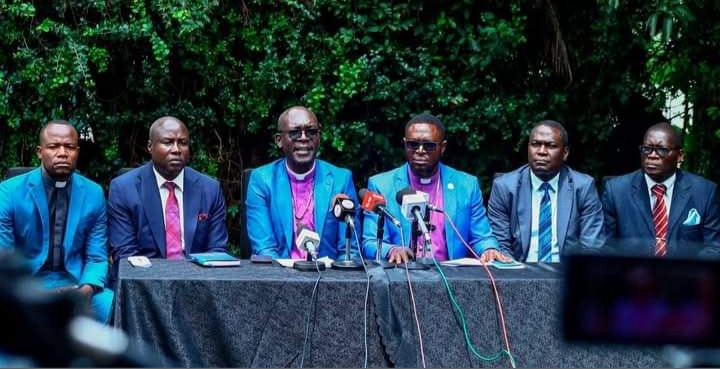
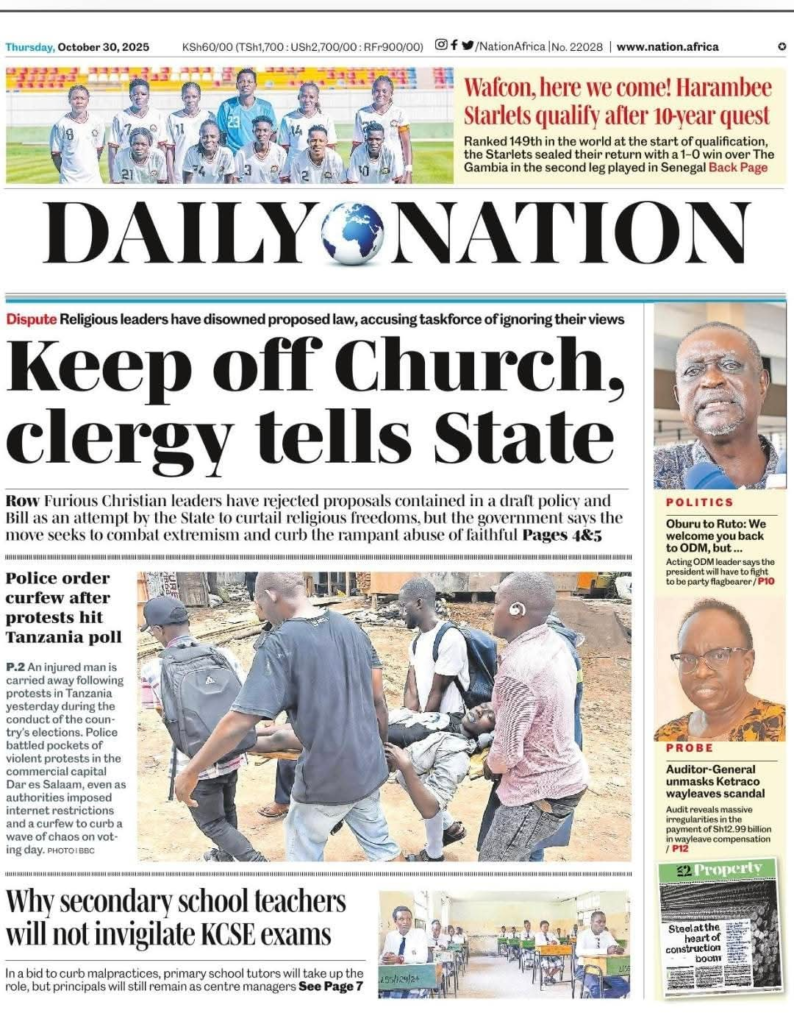
A proposal by the government to regulate religious activities in Kenya has sparked a heated reaction from both Christian and Muslim leaders, who have dismissed it as an attempt to suppress freedom of worship.
The Church and Clergy Association of Kenya (CCAK) has urged President William Ruto to allow faith-based groups to present their views before any decision is made.
The contentious proposals are contained in the Draft Religious Organisations Policy, 2024, and the accompanying Religious Organisations Bill, 2024.
These documents seek to establish a legal framework for the registration, monitoring, and regulation of churches, mosques, and other religious bodies.
The government argues that the move aims to prevent the rise of extremist ideologies and the misuse of religion for criminal activities.
However, religious leaders insist the proposals are unnecessary and “anti-Christian” in nature, warning that they could pave the way for government control over spiritual institutions.
Speaking during a press briefing in Nairobi, CCAK leaders criticized the government for crafting the proposals without consulting stakeholders in the faith community.
Bishop Hudson Ndeda described the bill as “discriminative and oppressive,” saying it would erode the hard-won right to freedom of association.
He further argued that the introduction of punitive fines, prison terms, and the creation of an umbrella regulatory body mirrors clauses from the Computer and Cybercrime Act, which he said were unfairly used to stifle expression.
“We reject these proposals in their entirety. They do not represent our values or the principles of faith. The government should not dictate how we worship or organize our religious work,” Bishop Ndeda said.
CCAK secretary general Bishop Jones Ochieng added that while the government’s concern about preventing tragedies such as the Shakahola massacre is valid, targeting all religious groups because of one incident would damage the long-standing cooperation between the state and religious institutions.
He noted that many religious organizations play a vital role in peace building, education, and social welfare, and should therefore be treated as partners rather than potential threats.
The government maintains that the proposals originated from the Presidential Taskforce on the Review of the Legal and Regulatory Framework Governing Religious Organisations, chaired by Reverend Mutava Musyimi.
Officials argue that the reforms are necessary to protect the public from exploitation by rogue preachers who misuse faith for personal gain.
The debate comes in the shadow of the Shakahola tragedy, where over 500 people died after being lured into starvation by a self-proclaimed pastor.
While the government views regulation as a preventive measure, religious leaders see it as an assault on their independence, setting the stage for a tense standoff over the future of religious freedom in Kenya.
Leave feedback about this