
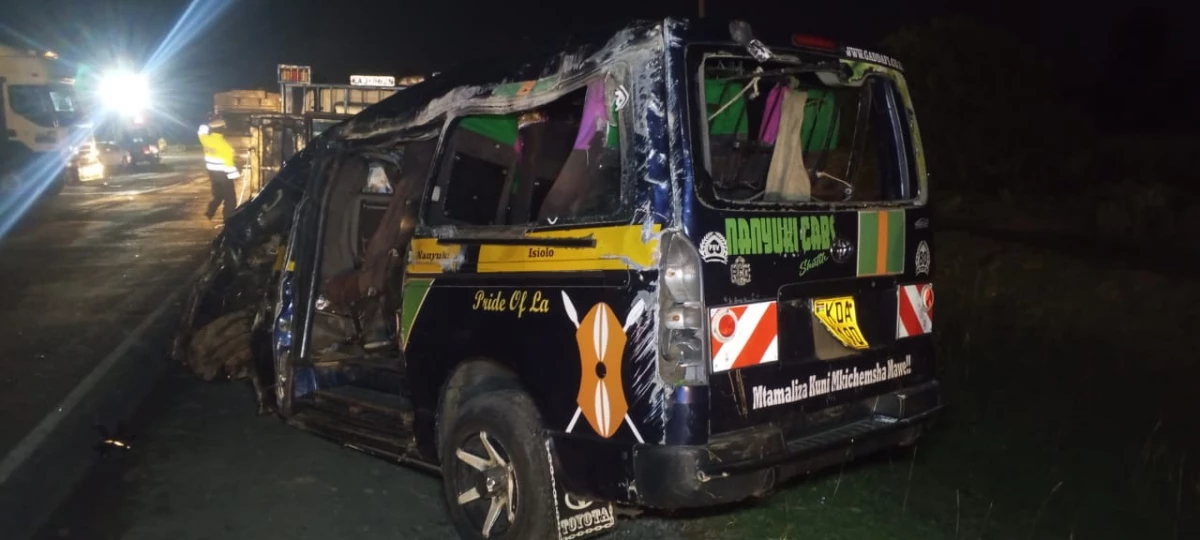
A fresh wave of grief has settled over families and communities along the Karai–Naivasha stretch of the Nairobi–Nakuru Highway after a tragic road accident claimed the lives of nine people.
The latest crash has once again drawn attention to a section of road that many now describe as a death trap, with residents saying accidents have become so frequent that shock has turned into painful familiarity.
When our reporter Serfine Achieng’ Ouma arrived at the scene shortly after the accident, traffic was still moving in both directions as if nothing had happened. Vehicles continued to speed past, some drivers attempting risky overtakes even as emergency responders worked nearby.
This behaviour, residents say, is part of the daily reality on this highway and one of the key reasons accidents keep happening.
The crash occurred near Eagle Petrol Station, a location locals are all too familiar with. Just a short distance away lies the scene of another fatal accident reported weeks earlier, which residents say claimed the life of former Lugari MP Cyrus Jirongo.
To many who live and work in the area, the closeness of these deadly incidents is not a coincidence but proof of a long-standing problem that has never been fully addressed.
Further along the road, closer to Karai, memories remain vivid of one of the most horrifying crashes in recent years. More than 40 people lost their lives when a tanker carrying highly flammable chemicals lost control, hit several vehicles, and burst into flames.
Witnesses still recall the massive fireball that followed, trapping people in their cars and leaving a trail of destruction that shocked the entire country.
For residents, that tragedy was not an isolated event but part of a growing pattern.The presence of a St John Ambulance trauma clinic right next to the highway quietly confirms what locals have known for years, that this stretch is officially recognised as a black spot. The clinic responds to accidents almost daily.
One resident, speaking with visible pain, said burials have become too common, adding that the number of graves keeps growing because crashes never seem to stop.
At the Naivasha Police Headquarters, the seriousness of the situation is impossible to ignore. The compound holds the remains of vehicles destroyed in past accidents, including a Greenline bus and a matatu that were recently written off.
Police officers confirm that hospitals in Naivasha and surrounding areas are struggling to cope with the number of injured victims brought in after crashes on this road.
Residents now want urgent action. They are calling on the Kenya National Highways Authority to redesign the highway, introduce clearer markings, improve signage, and put stronger measures in place to control speeding and reckless overtaking.
To them, these are not just technical upgrades but lifesaving steps.For families who have already lost loved ones, the appeal comes too late. Still, many hope their voices will be heard before another siren sounds, another family mourns, and another name is added to the long list of lives lost on this dangerous stretch of road.





Leave feedback about this