
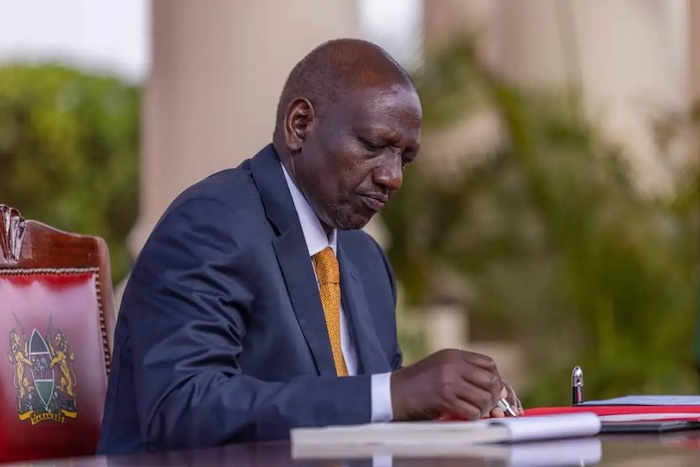
President William Ruto’s bid to expand executive control over State corporations has suffered a major legal defeat after the High Court nullified his Executive Order No. 3 of 2024.
The ruling, delivered by Justice Chacha Mwita, firmly established that the President had overstepped constitutional limits by attempting to take powers already assigned to the Public Service Commission (PSC).
Justice Mwita’s decision marks a turning point in Kenya’s governance framework, especially in defining the separation of powers between the Executive and independent commissions.
According to the court, the President’s directive, which aimed to centralize oversight of State corporations under his office, directly violated Article 234(2) of the Constitution.
That article gives the PSC exclusive authority to manage human resources in the public sector, including appointments, promotions, and disciplinary control.
The court went further to declare parts of the State Corporations Act unconstitutional. Specifically, Sections 5(3) and 27(c), which were used to justify the President’s actions, were found to be inconsistent with the Constitution.
Justice Mwita emphasized that no executive order or legislation can lawfully grant the Head of State powers that belong to an independent commission.
“The President cannot exercise powers that are constitutionally vested in the Public Service Commission,” the judge stated, underscoring that any attempt to bypass the PSC undermines the principles of good governance, accountability, and the rule of law.
Executive Order No. 3, issued on May 24, 2024, through a gazette notice, sought to bring the management of State corporations directly under the Office of the President.
It proposed new guidelines on board appointments, staff management, and the terms of service across parastatals areas that have traditionally been managed within the PSC’s framework.
However, the move quickly attracted opposition from constitutional watchdogs. The Law Society of Kenya (LSK) and the PSC filed a petition challenging the legality of the order, arguing that it threatened the independence of the public service by creating a parallel system outside the constitutional structure.
LSK maintained that the President’s directive amounted to an overreach that would weaken the PSC’s institutional role and open the door for political interference in civil service management.
In siding with the petitioners, the High Court reinforced the PSC’s role as the guardian of professionalism and impartiality in Kenya’s public administration.
Justice Mwita noted that Article 232 of the Constitution demands a merit-based and non-partisan public service, a standard that the Executive Order failed to uphold.
The ruling now forces both the Executive and Parliament to revisit the State Corporations Act and related statutes to ensure they align with constitutional provisions.
For President Ruto, the judgment represents a significant setback in his efforts to tighten control over government agencies, while for the judiciary and constitutional commissions, it stands as a reaffirmation of institutional independence and the supremacy of the Constitution.





Leave feedback about this