
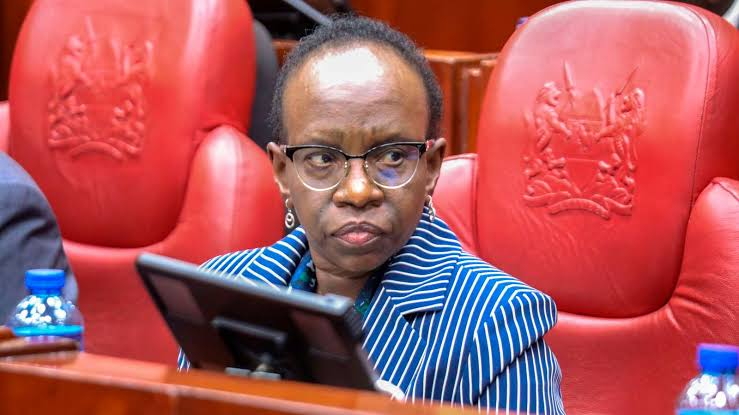
The latest audit findings have once again drawn attention to the growing problem of favoritism in county jobs.
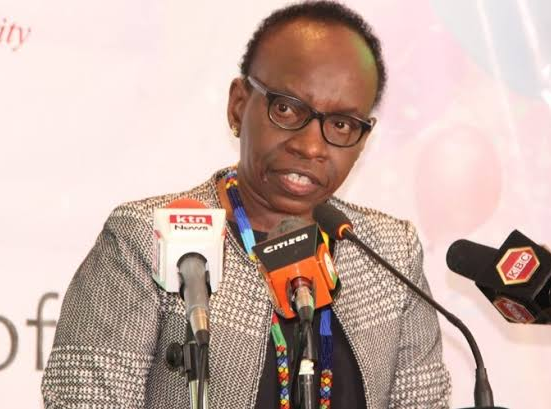
The Auditor General, Nancy Gathungu, in her 2023/2024 report, laid bare the way county officials have been ignoring the law when it comes to hiring, instead choosing to favor individuals from dominant ethnic groups.
The revelations have raised concerns that counties are not living up to the spirit of fairness and inclusivity required in public service.
The audit showed that in many counties, laws meant to protect diversity in employment have been openly disregarded.
According to The National Cohesion and Integration Act of 2008, no public office should employ more than a third of staff from a single community.
Likewise, the County Governments Act of 2012 provides that at least 30 percent of new appointments should come from ethnic groups other than the dominant one.
Despite these legal requirements, the report revealed that most counties are ignoring the rules, creating workplaces that reflect dominance rather than inclusion.
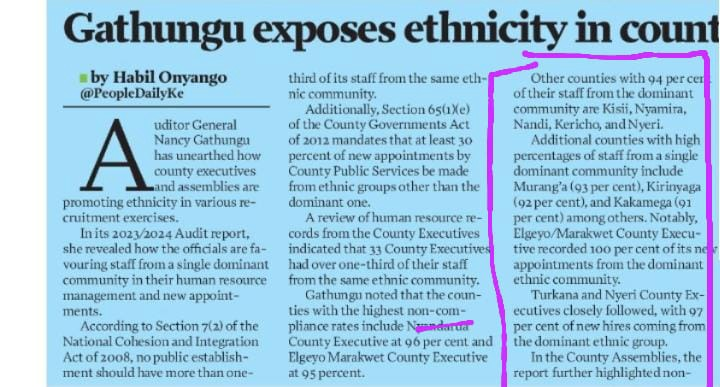
Nancy Gathungu’s report highlighted that 33 county executives exceeded the one-third ethnic limit. Uasin Gishu and Elgeyo Marakwet stood out as the worst offenders, with figures reaching 96 and 98 percent respectively.
Other counties such as Kisii, Nyamira, Nandi, Kericho, Kirinyaga, Murang’a, and Kakamega also recorded worrying levels of bias.
For instance, Murang’a had 93 percent of staff from one ethnic group while Kakamega was at 91 percent.
These numbers show a clear violation of the law and point to a systemic problem across the devolved units.
The situation is even worse in county assemblies. Out of 47 assemblies, 38 were found to have more than one-third of employees coming from a single ethnic group.
Nandi and Nyamira assemblies had the most shocking numbers, each hitting 99 percent dominance.
This level of exclusion raises concerns about how seriously county leaders take constitutional obligations and whether diversity is being undermined in favor of political or ethnic interests.
The Auditor General did not mince her words in warning against these practices.
She reminded counties that inclusivity is not a choice but a constitutional requirement. Gathungu stressed that failing to reflect Kenya’s diversity in public institutions weakens trust in government and risks deepening feelings of marginalization.
Her findings have fueled public outcry, with governance experts calling on the national government and oversight agencies to take immediate steps to enforce compliance.
If the problem is left unchecked, experts warn that it could entrench ethnic divisions and make counties breeding grounds for inequality.
The call for immediate corrective action now hangs over governors and assembly leaders, many of whom may find themselves under pressure to explain why they ignored laws that were put in place to guarantee fairness.
The audit has served as a reminder that building a cohesive country depends on institutions that represent all communities fairly and equally.



Leave feedback about this