
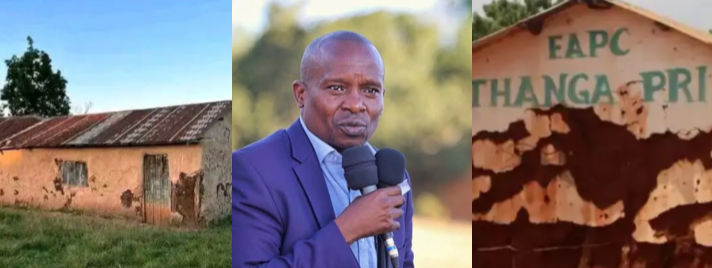
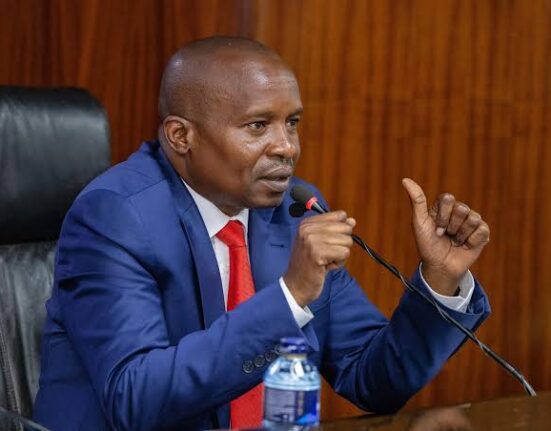
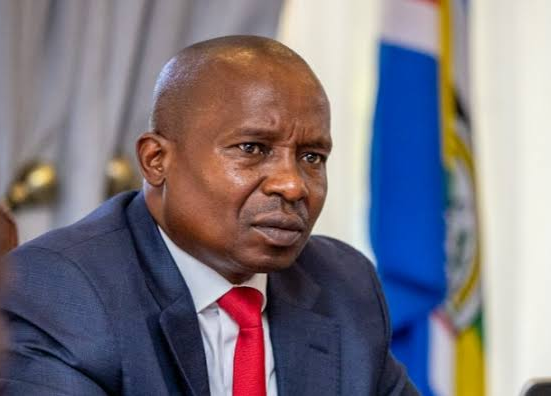
In Tharaka Nithi County, where Deputy President Kithure Kindiki comes from, schools are falling apart while he spends time and resources traveling across the country giving out money through empowerment programs.
Back home, children are learning in heartbreaking conditions. Parents and locals say the education system in the area has been forgotten, with many primary schools suffering from neglect.
At Kathanga Primary School, the situation is worse than many people imagine. The walls have huge holes, and the roofs leak when it rains, making it hard for children to concentrate.
The floors are dusty, and classrooms are barely fit for learning.
Simon Mwari, a parent, says his child can’t even hear the teacher properly because of the open walls and distractions. It’s not just one school—Kiairanthi, Gatiriku, Gakuyu, and Kathandeni face similar problems.
At Kiairanthi, there is an unfinished building divided using rusting iron sheets. Several classes are forced to learn in one cramped space, with no privacy or order.
Parents are heartbroken. Benard Kimathi shared that whenever their children travel for school trips and see clean, modern buildings, they feel like they’ve left Kenya.
This shows just how low the standards are in their own schools. Clean water and electricity are also missing in many of these schools.
Pupils are forced to walk long distances up to eight kilometers to fetch water from the Tana River.
Parents are expected to provide over 60 jerricans of water every school term.
A transformer that was brought during a past political campaign has never worked and now just makes noise, reminding residents of the empty promises they were fed.Dormitories are another nightmare.
In some schools, strong winds can collapse buildings. Dust covers everything, and according to one parent, it sometimes reaches the knees.
Teachers leave school looking completely different due to all the dust.
Even as these problems worsen, Deputy President Kindiki has continued to defend his countrywide tours and empowerment events, claiming that critics don’t understand the challenges Kenyans face.
But for people in Tharaka Nithi, it is hard to take that seriously when their children sit in broken classrooms and walk long distances just to get water. Frustration is growing fast. Residents are no longer staying silent.
They want answers, and more importantly, they want action. They are demanding that the deputy president stop ignoring his own backyard and focus on fixing the schools before talking about empowering anyone else.



Leave feedback about this